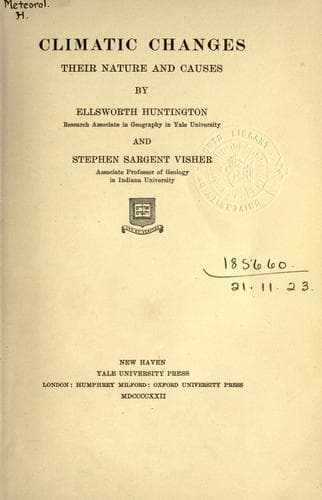
Climatic Changes: Their Nature and CausesHuntington, Ellsworth
Science
Climatic Changes: Their Nature and Causes
Huntington, Ellsworth
Climatic changes; Climatology; Paleoclimatology
The Eskimo invasion must not be regarded as a common raid. It was
the transmigration of a people, and like other big movements of this
kind [was] impelled by altered conditions of nature, in this case
the alterations of climate caused by [or which caused?] the advance
of the ice. For their hunting and fishing the Eskimos require an at
least partially open arctic sea. The seal, their principal prey,
cannot live where the surface of the sea is entirely frozen over.
The cause of the favorable conditions in the Viking-age was,
according to my hypothesis, that the ice then melted at a higher
latitude in the arctic seas.
The Eskimos then lived further north in Greenland and North America.
When the climate deteriorated and the sea which gave them their
living was closed by ice the Eskimos had to find a more suitable
neighborhood. This they found in the land colonized by the Norsemen
whom they attacked and finally annihilated.
Finally, far to the south in Yucatan the ancient Maya civilization made
its last flickering effort at about this time. Not much is known of this
but in earlier periods the history of the Mayas seems to have agreed
quite closely with the fluctuations in climate.[36] Among the Mayas, as
we have seen, relatively dry periods were the times of greatest
progress.
Let us turn now to Fig. 3 once more and compare the climatic conditions
of the fourteenth century with those of periods of increasing rainfall.
Southern England, Ireland, and Scandinavia, where the crops were ruined
by extensive rain and storms in summer, are places where storminess and
rainfall now increase when sunspots are numerous. Central Europe and the
coasts of the North Sea, where flood and drought alternated, are regions
which now have relatively less rain when sunspots increase than when
they diminish. However, as appears from the trees measured by Douglass,
the winters become more continental and hence cooler, thus corresponding
to the cold winters of the fourteenth century when people walked on the
ice from Scandinavia to Denmark. When such high pressure prevails in the
winter, the total rainfall is diminished, but nevertheless the storms
are more severe than usual, especially in the spring. In southeastern
Europe, the part of the area whence the Caspian derives its water,
appears to have less rainfall during times of increasing sunspots than
when sunspots are few, but in an equally large area to the south, where
the mountains are higher and the run-off of the rain is more rapid, the
reverse is the case. This seems to mean that a slight diminution in the
water poured in by the Volga would be more than compensated by the water
derived from Persia and from the Oxus and Jaxartes rivers, which in the
fourteenth century appear to have filled the Sea of Aral and overflowed
in a large stream to the Caspian. Still farther east in central Asia, so
Public-domain text, read in full here on John Shaqi.
Reviews
Reviews
No reviews yet
Be the first to share your thoughts on this work.
Elsewhere in the archive
Join the Discussion
Join the discussion
Sign in to leave a comment or review.
Sign InorCreate an account