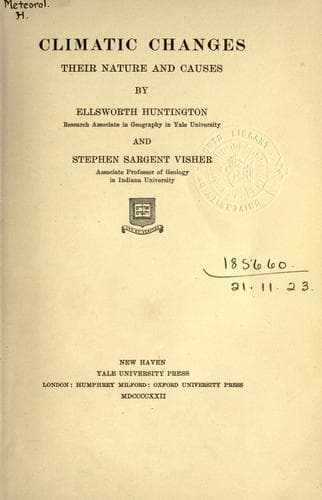
Climatic Changes: Their Nature and CausesHuntington, Ellsworth
Science
Climatic Changes: Their Nature and Causes
Huntington, Ellsworth
Climatic changes; Climatology; Paleoclimatology
far as the records go, most of the country receives more rain when
sunspots are many than when they are few, which would agree with what
happened when the Dragon Town was inundated. In India, on the contrary,
there is a large area where the rainfall diminishes at times of many
sunspots, thus agreeing with the terrible famine from which the Moguls
suffered so severely. In the western hemisphere, Greenland, Arizona, and
California are all parts of the area where the rain increases with many
sunspots, while Yucatan seems to lie in an area of the opposite type.
Thus all the evidence seems to show that at times of climatic stress,
such as the fourteenth century, the conditions are essentially the same
as those which now prevail at times of increasing sunspots.
As to the number of sunspots, there is little evidence previous to about
1750. Yet that little is both interesting and important. Although
sunspots have been observed with care in Europe only a little more than
three centuries, the Chinese have records which go back nearly to the
beginning of the Christian era. Of course the records are far from
perfect, for the work was done by individuals and not by any great
organization which continued the same methods from generation to
generation. The mere fact that a good observer happened to use his
smoked glass to advantage may cause a particular period to appear to
have an unusual number of spots. On the other hand, the fact that such
an observer finds spots at some times and not at others tends to give a
valuable check on his results, as does the comparison of one observer's
work with that of another. Hence, in spite of many and obvious defects,
most students of the problem agree that the Chinese record possesses
much value, and that for a thousand years or more it gives a fairly true
idea of the general aspect of the sun. In the Chinese records the years
with many spots fall in groups, as would be expected, and are sometimes
separated by long intervals. Certain centuries appear to have been
marked by unusual spottedness. The most conspicuous of these is the
fourteenth, when the years 1370 to 1385 were particularly noteworthy,
for spots large enough to be visible to the naked eye covered the sun
much of the time. Hence Wolf,[37] who has made an exhaustive study of
the matter, concludes that there was an absolute maximum of spots about
1372. While this date is avowedly open to question, the great abundance
of sunspots at that time makes it probable that it cannot be far wrong.
If this is so, it seems that the great climatic disturbances of which we
have seen evidence in the fourteenth century occurred at a time when
sunspots were increasing, or at least when solar activity was under some
profoundly disturbing influence. Thus the evidence seems to show not
merely that the climate of historic times has been subject to important
pulsations, but that those pulsations were magnifications of the little
Public-domain text, read in full here on John Shaqi.
Reviews
Reviews
No reviews yet
Be the first to share your thoughts on this work.
Elsewhere in the archive
Join the Discussion
Join the discussion
Sign in to leave a comment or review.
Sign InorCreate an account