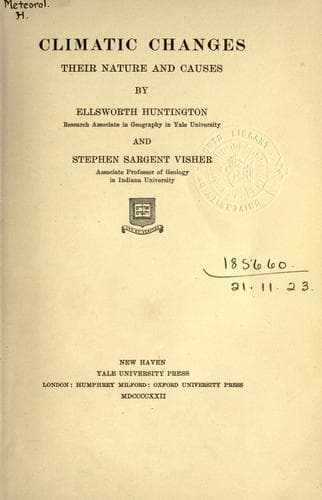
Climatic Changes: Their Nature and CausesHuntington, Ellsworth
Science
Climatic Changes: Their Nature and Causes
Huntington, Ellsworth
Climatic changes; Climatology; Paleoclimatology
climatic changes which now take place in sunspot cycles. The past and
the present are apparently a unit except as to the intensity of the
changes.
FOOTNOTES:
[Footnote 31: O. Pettersson: The connection between hydrographical and
meteorological phenomena; Quarterly Journal of the Royal Meteorological
Society, Vol. 38, pp. 174-175.]
[Footnote 32: A. Norlind: Einige Bemerkungen ueber das Klima der
historischen Zeit nebst einem Verzeichnis mittelaltlicher Witterungs
erscheinungen; Lunds Univ. Arsskrift, N. F., Vol. 10, 1914, 53 pp.]
[Footnote 33: Thorwald Rogers: A History of Agriculture and Prices in
England.]
[Footnote 34: E. Brueckner: Klimaschwankungen seit 1700, Vienna, 1891.]
[Footnote 35: For a full discussion of the changes in the Caspian Sea,
see The Pulse of Asia, pp. 329-358.]
[Footnote 36: S. Q. Morley: The Inscriptions at Copan; Carnegie Inst. of
Wash., No. 219, 1920.
Ellsworth Huntington: The Red Man's Continent, 1919.]
[Footnote 37: See summary of Wolf's work with additional information by
H. Fritz; Zuerich Vierteljahrschrift, Vol. 38, 1893, pp. 77-107.]
CHAPTER VII
GLACIATION ACCORDING TO THE SOLAR-CYCLONIC HYPOTHESIS[38]
The remarkable phenomena of glacial periods afford perhaps the best
available test to which any climatic hypothesis can be subjected. In
this chapter and the two that follow, we shall apply this test. Since
much more is known about the recent Great Ice Age, or Pleistocene
glaciation, than about the more ancient glaciations, the problems of the
Pleistocene will receive especial attention. In the present chapter the
oncoming of glaciation and the subsequent disappearance of the ice will
be outlined in the light of what would be expected according to the
solar-cyclonic hypothesis. Then in the next chapter several problems of
especial climatic significance will be considered, such as the
localization of ice sheets, the succession of severe glacial and mild
inter-glacial epochs, the sudden commencement of glaciation and the
peculiar variations in the height of the snow line. Other topics to be
considered are the occurrence of pluvial or rainy climates in
non-glaciated regions, and glaciation near sea level in subtropical
latitudes during the Permian and Proterozoic. Then in Chapter IX we
shall consider the development and distribution of the remarkable
deposits of wind-blown material known as loess.
Facts not considered at the time of framing an hypothesis are especially
significant in testing it. In this particular case, the cyclonic
hypothesis was framed to explain the historic changes of climate
revealed by a study of ruins, tree rings, and the terraces of streams
and lakes, without special thought of glaciation or other geologic
changes. Indeed, the hypothesis had reached nearly its present form
before much attention was given to geological phases of the problem.
Nevertheless, it appears to meet even this severe test.
Public-domain text, read in full here on John Shaqi.
Reviews
Reviews
No reviews yet
Be the first to share your thoughts on this work.
Elsewhere in the archive
Join the Discussion
Join the discussion
Sign in to leave a comment or review.
Sign InorCreate an account