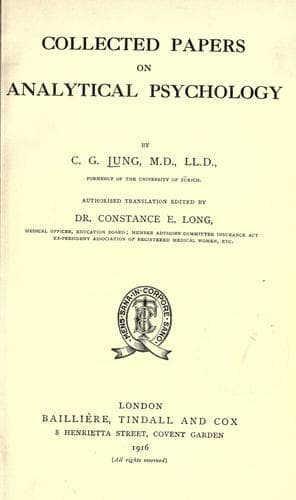
Collected Papers on Analytical PsychologyJung, C. G. (Carl Gustav)
Science
Collected Papers on Analytical Psychology
Jung, C. G. (Carl Gustav)
Psychoanalysis
Here we meet with a new and important feature in the little one's life:
that is, we meet with reveries, even a tendency towards poetic fancies
and melancholic attacks. All of them things which we are wont first
to encounter at a later period of life, at a time when the youth or
maiden is preparing to sever the family tie and to enter independently
upon life, but is still held back by an inward, painful feeling of
homesickness for the warmth of the parental hearth. At such a time the
youth begins to replace what is lacking with poetic fancies in order
to compensate for the deficiency. To approximate the psychology of a
four-year-old child to that of the youth approaching puberty will at
first sight seem paradoxical; the relationship lies, however, not in the
age but rather in the mechanism. The elegiac reveries express the fact
that a part of that love which formerly belonged, and should belong,
to a real object, is now _introverted_, that is, it is turned inward
into the subject and there produces an increased imaginative activity.
What is the origin of this _introversion_? Is it a psychological
manifestation peculiar to this age, or does it owe its origin to a
conflict?
This is explained in the following occurrence. It often happened that
Anna was disobedient to her mother, she was insolent, saying, "I am
going back to grandma."
Mother: "But I shall be sad when you leave me."
Anna: "Oh, but you have my little brother."
This reaction towards the mother shows what the little one was really
aiming at with her threats to go away again; she apparently wished to
hear what her mother would say to her proposal, that is, to see what
attitude her mother would actually assume to her, whether her little
brother had not ousted her altogether from her mother's regard. One
must, however, give no credence to this little trickster. For the child
could readily see and feel that, despite the existence of the little
brother, there was nothing essentially lacking to her in her mother's
love. The reproach to which she subjects her mother is therefore
unjustified, and to the trained ear this is betrayed by a slightly
affected tone. Such an unmistakable tone does not expect to be taken
seriously and hence it obtrudes itself more vehemently. The reproach
as such cannot be taken seriously by the mother, for it was only the
forerunner of other and this time more serious resistances. Not long
after the conversation narrated above, the following scene took place:
Mother: "Come, we are going into the garden now!"
Anna: "You are telling lies, take care if you are not telling the truth."
M.: "What are you thinking of? I _am_ telling the truth."
A.: "No, you are not telling the truth."
M.: "You will soon see that I am telling the truth: we are going into
the garden now."
A.: "Indeed, is that true? Is that really true? Are you not lying?"
Public-domain text, read in full here on John Shaqi.
Reviews
Reviews
No reviews yet
Be the first to share your thoughts on this work.
Elsewhere in the archive
Join the Discussion
Join the discussion
Sign in to leave a comment or review.
Sign InorCreate an account