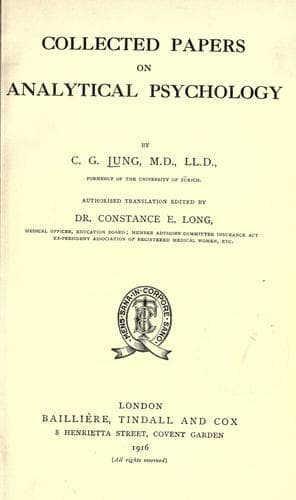
Collected Papers on Analytical PsychologyJung, C. G. (Carl Gustav)
Science
Collected Papers on Analytical Psychology
Jung, C. G. (Carl Gustav)
Psychoanalysis
For the patient any method that works is good, though some
more valuable than others--The doctor must choose what commends
itself to his scientific conscience--Why the author gave up the
use of hypnotism--Three cases quoted--Breuer and Freud's method
a great advance in psychic treatment--Evolution of author's
views--Importance of conception that behind the neurosis lies
a moral conflict--Divergence from Freud's sexual theory of
neurosis--The doctor's responsibility for the cleanliness of his
own hands--Necessity that the psychoanalyst should be analysed--He
is successful in so far as he has succeeded in his own moral
development.
LETTER III.--LOY 244
Opportunism _v._ scientific honour--Psychoanalysis no more
than hypnotism gets rid of "transference"--Cases of enuresis
nocturna, and of washing-mania treated by hypnosis--On what grounds
should such useful treatment be dispensed with?--The difficulty of
finding a rational solution for the moral conflict--The doctor's
dilemma of the two consciences.
LETTER IV.--JUNG 248
Author's standpoint that of the scientist, not
practical physician--The analyst works in spite of the
transference--Psychoanalysis not the only way--Sometimes less
efficacious than any known method--Cases must be selected--For the
author and his patients it is the best way--The real solution of
the moral conflict comes from within, and then only because the
patient has been brought to a new standpoint.
LETTER. V.--LOY 252
"What is truth?"--Parable of the prism--All man attains is
relative truth--Fanaticism is the enemy to science--Psychoanalysis
a method of dealing with basic motives of the human soul--Must not
each case be treated individually?--Morals are above all relative.
LETTER VI.--JUNG 256
Definition of psychoanalysis--Technique--So-called chance is
the law--Rules well-nigh impossible--The patients' unconscious is
the analysts' best confederate--Questions of morality and education
find solutions for themselves in later stages of analysis.
LETTER VII.--LOY 258
Contradictions in psychoanalytic literature--Should the doctor
canalise the patient's libido?--Does he not indirectly suggest
dreams to patient?
LETTER VIII.--JUNG 261
Public-domain text, read in full here on John Shaqi.
Reviews
Reviews
No reviews yet
Be the first to share your thoughts on this work.
Join the Discussion
Join the discussion
Sign in to leave a comment or review.
Sign InorCreate an account