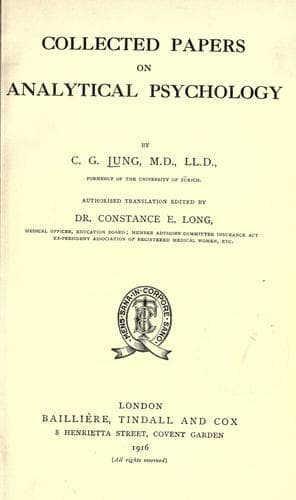
Collected Papers on Analytical PsychologyJung, C. G. (Carl Gustav)
Science
Collected Papers on Analytical Psychology
Jung, C. G. (Carl Gustav)
Psychoanalysis
Different view-points in psychoanalysis--_Vide_ Freud's
causality and Adler's finality--Discussion of meaning of
transference--The meaning of "line of least resistance"--Man as a
herd-animal--Rich endowment with social sense--Should take pleasure
in life--Error as necessary to progress as truth--Patient must be
trained in independence--Analyst is caught in his own net if he
makes hard-and-fast rules--Through the analyst's suggestion only
the outer form, never the content, is determined--The patient may
mislead the doctor, but this is disadvantageous and delays him.
LETTER IX.--LOY 267
The line of least resistance is a compromise with all
necessities--The analyst as accoucheur--The neurotic's faith in
authority--Altruism innate in man--He advances in response to his
own law.
LETTER X.--JUNG 270
Transference is the central problem of analysis--It may be
positive or negative--Projection of infantile phantasies on the
doctor--Biological "duties"--The psyche does not only react, but
gives its individual reply--We have an actual sexual problem
to-day--Evidences thereof--We have no real sexual morality, only
a legal attitude--Our moral views are too undifferentiated--The
neurotic is ill not because he has lost his faith in morality, but
because he has not found the new authority in himself.
CHAPTER X
ON THE IMPORTANCE OF THE UNCONSCIOUS IN PSYCHOPATHOLOGY 278
Content of the unconscious--Defined as sum of all psychical
processes below the threshold of consciousness--Answer to question
how does the unconscious behave in neurosis found in its effect
on normal consciousness--Example of a merchant--Compensating
function of the unconscious--Symptomatic acts--Nebuchadnezzar's
dream discussed--Intuitive ideas, and insane manifestations
both emanate from the unconscious--Eccentricities pre-exist
a breakdown--In mental disorder unconscious processes
break-through into consciousness and disturb equilibrium--True
also in fanaticism--Pathological compensation in case of
paranoia--Unconscious processes have to struggle against
resistances in the conscious mind--Distortion--In morbid conditions
the function of the unconscious is one of compensation.
CHAPTER XI
A CONTRIBUTION TO THE STUDY OF PSYCHOLOGICAL TYPES 287
Public-domain text, read in full here on John Shaqi.
Reviews
Reviews
No reviews yet
Be the first to share your thoughts on this work.
Join the Discussion
Join the discussion
Sign in to leave a comment or review.
Sign InorCreate an account