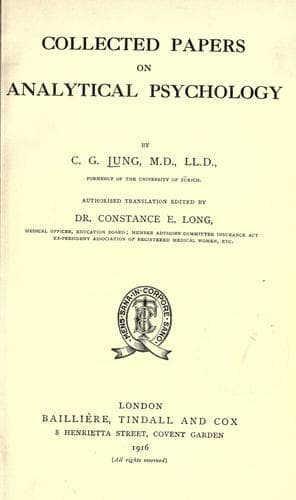
Collected Papers on Analytical PsychologyJung, C. G. (Carl Gustav)
Science
Collected Papers on Analytical Psychology
Jung, C. G. (Carl Gustav)
Psychoanalysis
It may be said of the dream that it enters into the consciousness as
a complex structure, the connection between the elements of which is
not conscious. Only by afterwards joining associations to the separate
pictures of the dream, can the origin of these pictures, in certain
recollections of the near and more remote past, be proved. One asks
oneself: "Where have I seen or heard that?" And by the same process of
free association comes the memory that one has actually experienced
certain parts of the dream, some of them yesterday, some at an earlier
date. This is well known, and every one will probably agree to it.
Thus far the dream presents itself, as a rule, as an incomprehensible
composition of certain elements which are not in the first instance
conscious, but which are later recognised by the process of free
association. This might be disputed on the ground that it is an _a
priori_ statement. I must remark, however, that this conception conforms
to the only generally recognised working hypothesis as to the genesis
of dreams, namely, the derivation of the dream from experiences and
thoughts of the recent past. We are, therefore, upon known ground.
Not that certain dream parts have under all circumstances been known
to the individual, so that one might ascribe to them the character of
being conscious; on the contrary, they are frequently, even generally,
unrecognisable. Not until later do we remember having consciously
experienced this or that dream part. We may therefore regard the dream
from this point of view as a product that comes from a subconscious
origin. The technical unfolding of these subconscious sources is a mode
of procedure that has always been instinctively employed. One simply
tries to remember whence the dream parts come. Upon this most simple
principle the psychoanalytic method of solving dreams is based. It
is a fact that certain dream parts are derived from our waking life
and, indeed, from experiences which, owing to their notorious lack of
importance, would frequently have been consigned to certain oblivion,
and were therefore well on their way towards becoming definitely
subconscious. Such dream parts are the results of subconscious
representations (images).
Public-domain text, read in full here on John Shaqi.
Reviews
Reviews
No reviews yet
Be the first to share your thoughts on this work.
Elsewhere in the archive
Join the Discussion
Join the discussion
Sign in to leave a comment or review.
Sign InorCreate an account