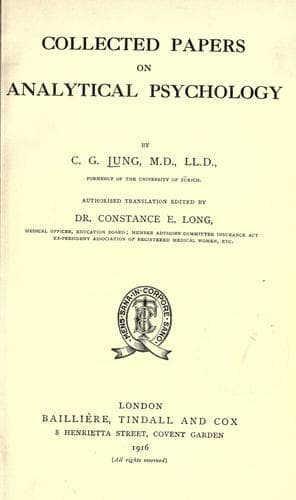
Collected Papers on Analytical PsychologyJung, C. G. (Carl Gustav)
Science
Collected Papers on Analytical Psychology
Jung, C. G. (Carl Gustav)
Psychoanalysis
The principles according to which psychoanalysis solves dreams are
therefore exceedingly simple, and have really been known for a long
time. The further procedure follows the same path logically and
consistently. If one spends considerable time over a dream, which
really never happens outside psychoanalysis, one can succeed in finding
more and more recollections for the separate dream parts. It is,
however, not always possible to discover recollections for certain
other parts; and then one must leave them for the time being, whether
one likes it or not. When I speak of "recollections" I naturally do
not mean merely memories of certain concrete experiences, but also of
their inter-related meanings. The collected recollections are known
as the dream material. With this material one proceeds according to a
scientific method that is universally valid. If one has any experimental
material to work up, one compares its separate parts and arranges them
according to their similarities. Exactly the same course is pursued
in dealing with the dream material; one gathers together its common
characteristics, whether these be formal or material. In doing this one
must absolutely get rid of certain prejudices. I have always observed
that the beginner expects to find some tendency or other according
to which he endeavours to mould his material. I have noticed this
particularly in the cases of colleagues who were previously more or
less violent opponents of psychoanalysis, owing to their well-known
prejudices and misunderstandings. When fate willed that I should analyse
them, and they consequently gained at last an insight into the method
of analysis, it was demonstrated that the first mistake which they had
been apt to make in their own psychoanalytic practice was that they
forced the material into accord with their own preconceived opinions;
that is, they allowed their former attitude towards psychoanalysis,
which they were not able to appreciate objectively, but only according
to subjective phantasies, to have its influence upon their material.
If one goes so far as to venture upon the task of examining the dream
material, one must permit no comparison to frighten one away. The
material consists, as a general rule, of very unequal images, from which
it is under some circumstances most difficult to obtain the "tertium
comparationis." I must forego giving you detailed examples of this,
since it is quite impossible to introduce such extensive material into a
lecture.
Public-domain text, read in full here on John Shaqi.
Reviews
Reviews
No reviews yet
Be the first to share your thoughts on this work.
Elsewhere in the archive
Join the Discussion
Join the discussion
Sign in to leave a comment or review.
Sign InorCreate an account