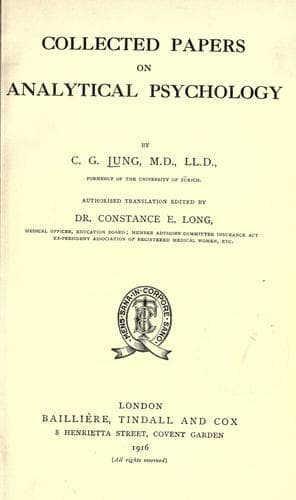
Collected Papers on Analytical PsychologyJung, C. G. (Carl Gustav)
Science
Collected Papers on Analytical Psychology
Jung, C. G. (Carl Gustav)
Psychoanalysis
One pursues, then, the same method in classifying the unconscious
content, as is used everywhere in comparing materials for the purpose
of drawing conclusions from them. One objection has often been made,
namely: why should the dream have a subconscious content at all? This
objection is unscientific in my opinion. Every psychological moment
has its own history. Every sentence that I utter has, besides the
meaning consciously intended by me, a meaning that is historical; and
this last may be entirely different from the conscious meaning. I am
purposely expressing myself somewhat paradoxically. I certainly should
not take it upon myself to explain each sentence according to its
individual-historical meaning. That is easier in the case of larger and
more complex formations. Every one is certainly convinced of the fact
that a poem--in addition to its manifest contents--is also particularly
characteristic of its author, in its form, subject-matter, and the
history of its origin. Whereas the poet gave skilful expression to
a fleeting mood in his song, the historian of literature sees in it
and beyond it, things which the poet would never have suspected. The
analysis which the literary critic makes of the subject-matter furnished
by the poet may be compared with psychoanalysis in its method, even to
the very errors which occur therein. The psychoanalytic method may be
aptly compared with historical analysis and synthesis. Let us assume,
for instance, that we do not understand the meaning of the rite of
baptism as it is practised in our churches to-day. The priest tells
us that baptism means the reception of the child into the Christian
community. But we are not satisfied with this. Why should the child be
sprinkled with water, etc.? In order that we may understand this rite we
must gather together materials for comparison from the history of the
rite, that is, from the memories of mankind appertaining to it; and this
must be done from various points of view.
Firstly--Baptism is clearly a rite of initiation, a consecration.
Therefore those memories, above all, must be assembled which preserve
the rites of initiation.
Secondly--The act of baptism is performed with water. This especial form
of procedure proves the necessity of welding together another chain of
memories concerning rites in which water was used.
Thirdly--The child is sprinkled with water when it is christened. In
this case we must gather together all the forms of the rite, where the
neophyte is sprinkled or where the child is submerged, etc.
Fourthly--We must recollect all the reminiscences in mythology and
all the superstitious customs which are in any respect similar to the
symbolic act of baptism.
Public-domain text, read in full here on John Shaqi.
Reviews
Reviews
No reviews yet
Be the first to share your thoughts on this work.
Elsewhere in the archive
Join the Discussion
Join the discussion
Sign in to leave a comment or review.
Sign InorCreate an account