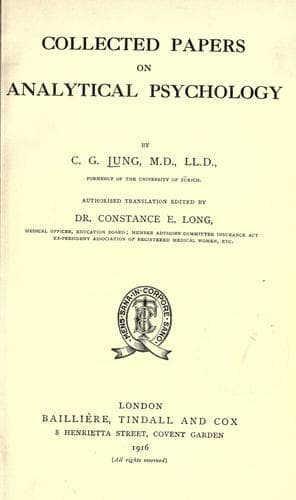
Collected Papers on Analytical PsychologyJung, C. G. (Carl Gustav)
Science
Collected Papers on Analytical Psychology
Jung, C. G. (Carl Gustav)
Psychoanalysis
I cannot but agree with your observation that confusion reigns in
psychoanalytic literature. Just at this moment different points of view
are developing in the theoretical conception of the analytic results;
not to mention many individual deviations. Over against Freud's almost
purely _causal_ conception, there has developed, apparently in absolute
contradiction, Adler's purely _final_ view, but in reality the latter
is an essential complement of Freud's theory. I hold rather to a middle
course, taking into account both standpoints. That discord still reigns
round the ultimate questions of psychoanalysis need not surprise us
when we consider the difficulty. The problem of the therapeutic effect
of psychoanalysis is bound up in particular with supremely difficult
questions, so that it would indeed be astonishing if we had yet
reached final certitude. Stekel's statement to which you refer is very
characteristic. What he says about love for the doctor is obviously
true, but it is a simple affirmation, and not a goal or plumb-line of
the analytic therapy. If his statement were the goal, many cures, it is
true, would be possible, but also many calamities might result which are
avoidable. But the aim is so to educate the patient that he will get
well for his own sake and by reason of his own determination, rather
than to procure his doctor some sort of advantage; though of course
it would be absurd from the therapeutic standpoint not to allow the
patient to get better because in doing so he does the doctor a good turn
also. It suffices if the patient knows it. But we must not prescribe
for him which path he should take to recovery. Naturally it seems to me
(from the psychoanalytic standpoint) an inadmissible use of suggestive
influence if the patient is compelled to get better out of love for
the doctor. And indeed such compulsion may sometimes take bitter
revenge. The "you must and shall be saved" is no more to be commended in
nerve-therapy than in any other department of life. It contradicts the
principle of analytic treatment, which shuns all coercion and desires
to let everything grow up from within. I do not, as you know, object to
influencing by use of suggestion in general, but merely to a doubtful
motivation. If the doctor demands that his patient shall get well from
love of himself, the patient may easily reckon on reciprocal services
and will without doubt try to extort them. I can but utter a warning
against any such method. A far stronger motive for recovery--also a far
healthier and ethically more valuable one--consists in the patient's
thorough insight into the real state of affairs, the recognition of how
things are now and how they ought to be. The man of any sort of worth
will then discern that he can hardly sit down at ease in the quagmire of
his neurosis.
Public-domain text, read in full here on John Shaqi.
Reviews
Reviews
No reviews yet
Be the first to share your thoughts on this work.
Elsewhere in the archive
Join the Discussion
Join the discussion
Sign in to leave a comment or review.
Sign InorCreate an account