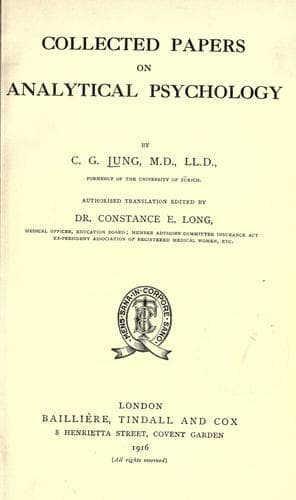
Collected Papers on Analytical PsychologyJung, C. G. (Carl Gustav)
Science
Collected Papers on Analytical Psychology
Jung, C. G. (Carl Gustav)
Psychoanalysis
With your rendering of what I said about the healing power of
personality I cannot entirely agree. I wrote that the doctor's
personality has a power for healing because the patient reads the
doctor's personality: not that he produces a cure through _love_ of the
doctor. The doctor cannot prevent the patient's beginning to behave
himself towards _his_ conflicts just as the doctor himself behaves,
for nothing is finer than a neurotic's intuition. _But every strong
transference serves this same purpose._ If the doctor makes himself
charming, he buys off from the patient a series of resistances which he
should have overcome, and whose overcoming will certainly have to be
gone through later on. Nothing is won by this technique; at most the
beginning of the analysis is made easy for the patient (though this is
not quite without its use in certain cases). To be able to crawl through
a barbed wire fence without some enticing end in view testifies to an
ascetic strength of will which you can expect neither from the ordinary
person nor from the neurotic. Even the Christian religion, whose moral
demands certainly reached a great height, thought it no scorn to
represent the near approach of the Kingdom of Heaven as goal and reward
of earthly pain. In my view, the doctor may well speak of the rewards
which follow the toils of analysis. But he must not depict himself or
his friendship, in hints or promises, as reward, if he is not seriously
determined to keep his word.
In regard to your criticism of my outline-definition of the conception
of psychoanalysis, it must be observed that the road over the steep
mountain is the line of least resistance only when a ferocious bull
waits for you in the pleasant valley-road. In other words, the line
of least resistance is a compromise with _all_ demands, and not
with inertia alone. It is prejudice to think that the line of least
resistance coincides with the path of inertia. (That's what we thought
in the days when we dawdled over Latin exercises.) Inertia is only an
immediate advantage and leads to consequences which produce the worst
resistances; as a whole, it does not lie in the direction of least
resistance. Life along the line of least resistance is not synonymous
with a man's regardless pursuit of his own egoistic desires. He who
lives thus soon painfully perceives that he is not moving along the line
of least resistance, for he is also a social being, and not merely a
bundle of egoistic instincts, as some people rather like to depict him.
This is best seen among primitive men and herd-animals, who all have a
richly developed social sense. Without it, indeed, the herd could not
exist at all. Man as herd-animal has therefore by no manner of means to
subject himself to laws enforced on him from without; he carries his
social imperatives within himself, _a priori_, as an inborn necessity.
As you see, I here put myself in decided opposition to certain views--I
Public-domain text, read in full here on John Shaqi.
Reviews
Reviews
No reviews yet
Be the first to share your thoughts on this work.
Elsewhere in the archive
Join the Discussion
Join the discussion
Sign in to leave a comment or review.
Sign InorCreate an account