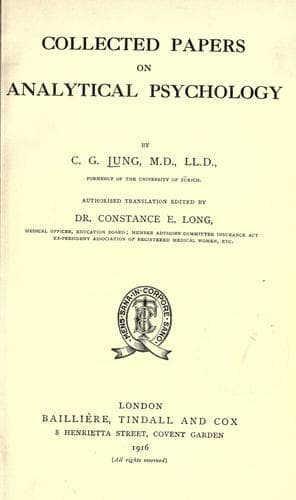
Collected Papers on Analytical PsychologyJung, C. G. (Carl Gustav)
Science
Collected Papers on Analytical Psychology
Jung, C. G. (Carl Gustav)
Psychoanalysis
think quite unjustified--which have been put forth here and there
inside the psychoanalytic movement.
So the line of least resistance does not signify _eo ipso_ the avoidance
of unpleasure so much as the just balancing of unpleasure and pleasure.
Painful activity by itself leads to no result but exhaustion. Man must
be able to take pleasure in his life, or the struggle of life has no
reward. What direction the patient's future life should take is not ours
to judge. We must not imagine we know better than his own nature--or
we prove ourselves educators of the worst kind. Psychoanalysis is but
a means of removing stones from the path, and in no way a method (as
hypnotism often pretends to be) of putting anything into the patient
which was not there before. So we renounce any attempt to give a
direction, and occupy ourselves only with setting in proper relief
all that analysis brings into the light of day, in order that the
patient may see clearly, and be in a position to draw the appropriate
conclusions. Anything that he has not himself won, he does not in
the long run believe in; and all that he has received from authority
keeps him still infantile. He must rather be put in such a position as
will enable him to take control of his own life. It is the art of the
psychoanalyst to follow the patient's apparently mistaken paths without
prejudice, and thus to discover his strayed and separated sheep. Working
on a system, according to a preconceived scheme, we spoil the best
results of the analysis. So I hold fast to the maxim you quote from me:
"Every interference on the part of the analyst is a gross mistake in
technique. So-called chance is the law and the order of psychoanalysis."
You surely recognise that the schoolmaster-view never releases us
from the attempt to correct Nature and the desire to force upon her
our limited "truths." In nerve-therapy we get so many wonderful
experiences--unforeseen and impossible to foresee--that surely we ought
to dismiss all hope of being infallibly able to point out the right
path. The roundabout way and even the wrong way are necessary. If you
deny this you must also deny that the errors in the history of the
whole world have been necessary. That indeed were a world-conception fit
for a schoolmaster. For psychoanalysis this view suits not at all.
Public-domain text, read in full here on John Shaqi.
Collected Papers on Analytical Psychology — John Shaqi
Reviews
Reviews
No reviews yet
Be the first to share your thoughts on this work.
Elsewhere in the archive
Join the Discussion
Join the discussion
Sign in to leave a comment or review.
Sign InorCreate an account