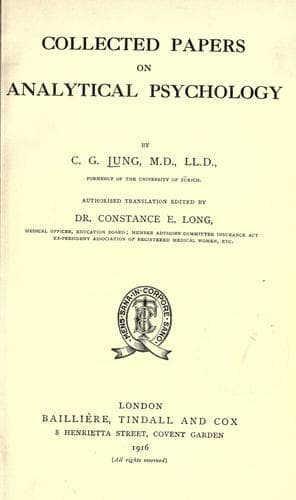
Collected Papers on Analytical PsychologyJung, C. G. (Carl Gustav)
Science
Collected Papers on Analytical Psychology
Jung, C. G. (Carl Gustav)
Psychoanalysis
The question as to how much the analyst involuntarily suggests to
the patient is a very ticklish one. Undoubtedly that has a much more
important place than psychoanalysts have till now admitted. Experience
has convinced us that the patient rapidly avails himself of the ideas
won through the analysis, and of whatever comes to light through the
shaping of the dreams. You may obtain all manner of such impressions
from Stekel's book: "Die Sprache des Traumes" ("The Language of the
Dream"). I had once a most instructive experience: a very intelligent
lady had from the beginning extreme transference phantasies which
appeared in well-recognised erotic forms. Nevertheless she entirely
declined to admit their existence. Of course she was betrayed by the
dreams in which my own person was hidden behind some other figure, and
often difficult to unveil. A long series of such dreams forced me at
last to say: "So you see it is always like that, and the person of whom
one has really dreamt is replaced and hidden by some one else in the
manifest dream." Till then the patient had obstinately contested this
point. But this time she could no longer evade it, and had to admit my
rule--but only that she might play me a trick. Next day she brought me a
dream in which she and I appeared in a manifest lascivious situation. I
was naturally perplexed and thought of my rule. Her first association to
the dream was the malicious question: "It's always true, isn't it, that
the person of whom one is really dreaming is replaced by some one else
in the manifest dream-content?"
Clearly, she had made use of her experience to find a protective formula
by means of which she secured the open expression of her phantasies in
an apparently innocent way.
This example aptly shows how patients avail themselves of insight
gained during analysis; they use it symbolically. You get caught in
your own net if you give credence to the idea of unalterable, permanent
symbols. That has already happened to more than one psychoanalyst. It
is therefore fallacious to try to prove any particular theory from the
dreams arising in the course of analysis. For this purpose the only
conclusive dreams are those derived from demonstrably uninfluenced
persons. In such cases one would only have to exclude the possibility of
telepathic thought-reading. But if you concede this possibility you will
have to subject very many things to a rigorous re-examination and, among
others, many judicial verdicts.
Public-domain text, read in full here on John Shaqi.
Reviews
Reviews
No reviews yet
Be the first to share your thoughts on this work.
Elsewhere in the archive
Join the Discussion
Join the discussion
Sign in to leave a comment or review.
Sign InorCreate an account