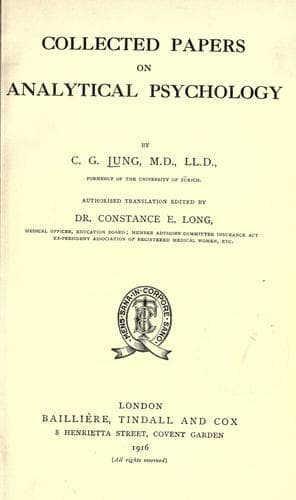
Collected Papers on Analytical PsychologyJung, C. G. (Carl Gustav)
Science
Collected Papers on Analytical Psychology
Jung, C. G. (Carl Gustav)
Psychoanalysis
But although we must do full justice to the force of suggestion, we must
not overrate it. The patient is no empty sack into which you may stuff
whatever you like; on the contrary, he brings his own predetermined
contents which strive obstinately against suggestion and always obtrude
themselves afresh. Through analytic "suggestions," only the outward
_form_ is determined, never the content--this is always being freshly
impressed upon my notice. The form is the unlimited, the ever-changing;
but the content is fixed, and only to be assailed slowly and with great
difficulty. Were it not so, suggestion-therapy would be in every respect
the most effective, profitable, and easiest therapy,--a real panacea.
That, alas! it is not, as every honourable hypnotist will freely admit.
To return to your question as to how far it is conceivable that patients
may deceive the doctor by making use--perhaps involuntarily--of his
expressions: this is indeed a very serious problem. The analyst must
exercise all possible care and practise unsparing self-criticism if
he would avoid, as far as possible, being led into error by patients'
dreams. It may be admitted that they almost always use modes of
expression in their dreams learnt in analysis--some more, some less.
Interpretations of earlier symbols will themselves be used again as
fresh symbols in later dreams. It happens not seldom, for instance, that
sexual situations which appear in symbolic form in the earlier dreams,
will appear "undisguised" in later ones, and here again they are the
symbolic expression of ideas of another character capable of further
analysis. The not infrequent dream of incestuous cohabitation is by
no means an "undisguised" content, but a dream as freshly symbolic and
capable of analysis as all others. You surely only reach the paradoxical
view that such a dream is "undisguised" if you are pledged to the sexual
theory of neurosis.
That the patient may mislead the doctor for a longer or shorter time by
means of deliberate deception and misrepresentation is possible; just as
occasionally happens in all other departments of medicine. Therewith the
patient injures himself most, since he has to pay for every deception
or suppression, with aggravated or additional symptoms. Deceptions are
so obviously disadvantageous to himself that in the end he can scarcely
avoid the definite relinquishment of such a course.
The technique of analysis we can best postpone for oral discussion.
IX
_From Dr. Loÿ._
23rd February, 1913.
Public-domain text, read in full here on John Shaqi.
Reviews
Reviews
No reviews yet
Be the first to share your thoughts on this work.
Elsewhere in the archive
Join the Discussion
Join the discussion
Sign in to leave a comment or review.
Sign InorCreate an account