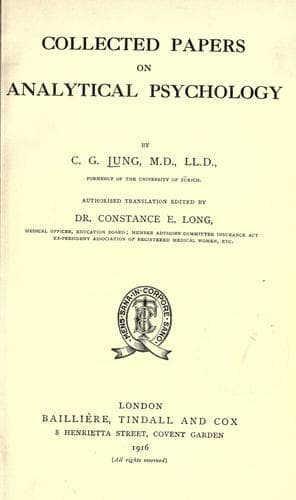
Collected Papers on Analytical PsychologyJung, C. G. (Carl Gustav)
Science
Collected Papers on Analytical Psychology
Jung, C. G. (Carl Gustav)
Psychoanalysis
From your letter of 16th February I want first to single out the
end, where you so admirably assign to its proper place the power of
suggestion in psychoanalysis: "The patient is no empty sack, into which
you can cram what you will; he brings his own predetermined content
with him, with which one has always to reckon afresh." With this I
fully agree, my own experience confirms it. And you add: "This content
remains untouched by involuntary analytical suggestion, but its form is
altered, proteus-fashion, beyond measure." So it becomes a matter of
a sort of "mimicry" by which the patient seeks to escape the analyst,
who is driving him into a corner and therefore for the moment seems
to him an enemy. Until at last, through the joint work of patient and
analyst--the former spontaneously yielding up his psychic content,
the latter only interpreting and explaining--the analysis succeeds in
bringing so much light into the darkness of the patient's psyche that
he can see the true relationships and, without any preconceived plan of
the analyst's, can himself draw the right conclusions and apply them
to his future life. This new life will betake itself along the line of
least resistance--or should we not rather say, the least resistances,
as a "compromise with all the necessities," in a just balancing of
pleasure and unpleasure? It is not we who must arbitrarily seek to
determine how matters stand for the patient and what will benefit him;
his own nature decides. In other words, we must assume the _rôle_ of
the accoucheur who can bring out into the light of day a child already
alive, but who must avoid a series of mistakes if the child is to remain
able to live and the mother is not to be injured. All this is very
clear to me, since it is only the application to the psychoanalytic
method of a general principle which should have universal validity:
never do violence to Nature. Hence I also see that the psychoanalyst
must follow his patient's apparently "wrong roads" if the patient is
ever to arrive at his own convictions and be freed once and for all
from infantile reliance on authority. We ourselves as individuals have
learnt or can only learn by making mistakes how to avoid them for the
future, and mankind as a whole has created the conditions of its present
and future stages of development quite as much by frequent travel along
wrong paths as along the right road. Have not many neurotics--I do not
know if you will agree, but I think so--become ill partly for the very
reason that their infantile faith in authority has fallen to pieces?
Now they stand before the wreckage of their faith, weeping over it, in
dire distress because they cannot find a substitute which shall show
them clearly whither their life's course should now turn. So they remain
stuck fast betwixt infancy which they must unwillingly renounce, and the
serious duties of the present and future (the moral conflict). I see,
Public-domain text, read in full here on John Shaqi.
Reviews
Reviews
No reviews yet
Be the first to share your thoughts on this work.
Elsewhere in the archive
Join the Discussion
Join the discussion
Sign in to leave a comment or review.
Sign InorCreate an account