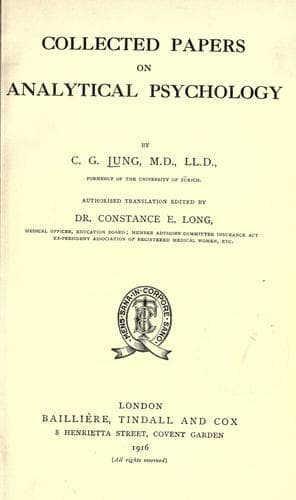
Collected Papers on Analytical PsychologyJung, C. G. (Carl Gustav)
Science
Collected Papers on Analytical Psychology
Jung, C. G. (Carl Gustav)
Psychoanalysis
particularly in such cases, you are right in saying it is a mistake to
seek to replace the lost faith in authority by another similar faith,
certain to be useful only so long as the belief lasts. This applies to
the deliberate use of suggestion in psychoanalysis, and the building
upon the transference to the doctor as the object of the analytic
therapy. I am no longer in doubt about your maxim: "Every interference
on the analyst's part is a gross mistake in technique. So-called chance
is the law and the order of psychoanalysis." Further, I am entirely
in agreement with you when you say that _altruism necessarily must be
innate in man considered as a herd-animal_. The contrary would be the
thing to be wondered at.
I should be much disposed to agree that not the egoistic, but the
altruistic instincts are primary. Love and trust of the child for the
mother who feeds it, nurses, cherishes and pets it,--love of the man for
his wife, regarded as the going out towards another's personality,--love
for offspring, care for it,--love for kinsfolk, etc. The egoistic
instincts owe their origin to the desire for exclusive possession of
all that surrounds love, the desire to possess the mother exclusively,
in opposition to the father and the brothers and sisters, the desire
to have a woman for himself alone, the desire to possess exclusively
ornaments, clothing, etc. But perhaps you will say I am paradoxical
and that the instincts, egoistic or altruistic, arise together in the
heart of man, and that every instinct is ambivalent in nature. But I
have to ask if the feelings and instincts are really ambivalent? Are
they exactly bipolar? Are the qualities of all emotions altogether
comparable? Is love really the opposite of hate?
However that may be, in any case it is well that man bears the social
law within himself, as an inborn imperative; otherwise our civilised
humanity would fare badly, having to subject themselves to laws imposed
on them from outside only: they would be impervious to the inheritance
of the earlier religious faiths, and would soon fall into complete
anarchy. Man would then have to ask himself whether it would not be
better to maintain by force an extreme belief in religious authority
such as prevailed in the Middle Ages. For the benefits of civilisation,
which strove to grant every individual as much outward freedom as was
consistent with the freedom of others, would be well worth the sacrifice
of free research. But the age of this use of force against nature is
past, civilised man has left this wrong track behind, not arbitrarily,
but obeying an inner necessity, and we may look joyfully towards the
future. Mankind, advancing in knowledge, will find its way across the
ruins of faith in authority to the moral autonomy of the individual.
X
_From Dr. Jung._
March, 1913.
Public-domain text, read in full here on John Shaqi.
Reviews
Reviews
No reviews yet
Be the first to share your thoughts on this work.
Elsewhere in the archive
Join the Discussion
Join the discussion
Sign in to leave a comment or review.
Sign InorCreate an account