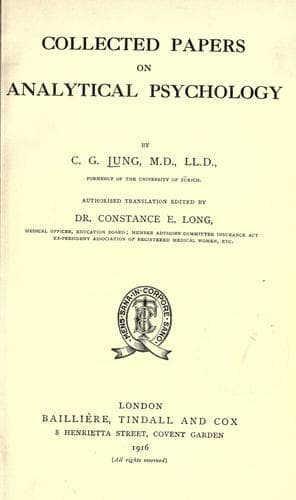
Collected Papers on Analytical PsychologyJung, C. G. (Carl Gustav)
Science
Collected Papers on Analytical Psychology
Jung, C. G. (Carl Gustav)
Psychoanalysis
In order to get a better grasp of the situation in connexion with
mental disorders, we may profitably consider first how unconscious
psychic material behaves in the case of normal people, especially
trying to visualize what in normal men is apt to be unconscious. As
a preliminary to this knowledge we must get a complete understanding
of what is contained in the conscious mind; and then, by a process of
elimination we may expect to find what is contained in the unconscious,
for obviously--_per exclusionem_--what is in the conscious cannot be
unconscious. For this purpose we examine all activities, interests,
passions, cares, and joys, which are conscious to the individual. All
that we are thus able to discover becomes, _ipso facto_, of no further
moment as a content of the unconscious, and we may then expect to find
only those things contained in the unconscious which we have not found
in the conscious mind.
Let us take a concrete example: A merchant, who is happily married,
father of two children, thorough and painstaking in his business
affairs, and at the same time trying in a reasonable degree to improve
his position in the world, carries himself with self-respect, is
enlightened in religious matters, and even belongs to a society for the
discussion of liberal ideas.
What can we reasonably consider to be the content of the unconscious in
the case of such an individual?
Considered from the above theoretical standpoint, everything in the
personality that is not contained in the conscious mind should be
found in the unconscious. Let us agree, then, that this man consciously
considers himself to possess all the fine attributes we have just
described--no more, no less. Then it must obviously result that he is
entirely unaware that a man may be not merely industrious, thorough,
and painstaking, but that he may also be careless, indifferent,
untrustworthy; for some of these last attributes are the common heritage
of mankind and may be found to be an essential component of every
character. This worthy merchant forgets that quite recently he allowed
several letters to remain unanswered which he could easily have answered
at once. He forgets, too, that he failed to bring a book home which his
wife has asked him to get at the book-stall, where she had previously
ordered it, although he might easily have made a note of her wish.
But such occurrences are common with him. Therefore we are obliged to
conclude that he is also lazy and untrustworthy. He is convinced that he
is a thoroughly loyal subject; but for all that he failed to declare the
whole of his income to the assessor, and when they raise his taxes, he
votes for the Socialists.
Public-domain text, read in full here on John Shaqi.
Reviews
Reviews
No reviews yet
Be the first to share your thoughts on this work.
Elsewhere in the archive
Join the Discussion
Join the discussion
Sign in to leave a comment or review.
Sign InorCreate an account