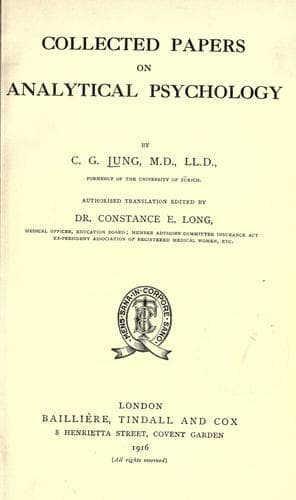
Collected Papers on Analytical PsychologyJung, C. G. (Carl Gustav)
Science
Collected Papers on Analytical Psychology
Jung, C. G. (Carl Gustav)
Psychoanalysis
Neither regressive restoration of the persona,
nor identification with collective psyche solves the
problem--Psychology will have to admit a plurality of
principles--Only the collective part of individual psychology
can be the subject of scientific study--What belongs to the
psychology of the individual requires its own text-book--The
persona must be strictly separated from the concept of the
individual--What is individual is the remnant which can
never be merged into the collective--Analysis of the persona
transfers greater value on to the individuality, increasing its
conflict with collectivity--The persona is identical with a
one-sided attitude, being a typical attitude in which thought
or feeling or intuition dominates, causing relative repression
of the other functions--Dissolution of persona indispensable
to individuation--The more individual a person is the more he
assimilates and develops those attributes that are the basis of a
collective concept of human nature--Unifying function between the
conscious and unconscious, between the collective and individual is
found in the phantasies--Phantasy the creative soil for everything
that has brought development to humanity--Phantasy not to be
taken literally but hermeneutically--Hermeneutics adds analogies
to those already given--Hermeneutical interpretation indicates
the means of synthesis of the individual, provided as soon as the
symbolic outlines of the path are understood they are followed
up--Co-operation and honest endeavour essential to cure--The moral
factor determines the cure--"Life-lines" have a short and ephemeral
value--Dreams are compensatory to conscious thinking--Watch must be
kept for dreams indicative of causes of error--Hence the patient
must remain in contact with the unconscious--End of analysis
reached when enough psychological insight and mastery of technique
is acquired to enable individual to follow his ever-changing
life-line, and to retain hold on the libido currents which give
conscious support to his individuality.
SUMMARY 472
INDEX 475
ANALYTICAL PSYCHOLOGY
CHAPTER I
ON THE PSYCHOLOGY AND PATHOLOGY OF SO-CALLED OCCULT PHENOMENA[1]
In that wide field of psychopathic deficiency where Science has
demarcated the diseases of epilepsy, hysteria and neurasthenia, we meet
scattered observations concerning certain rare states of consciousness
as to whose meaning authors are not yet agreed. These observations
spring up sporadically in the literature on narcolepsy, lethargy,
_automatisme ambulatoire_, periodic amnesia, double consciousness,
somnambulism, pathological dreamy states, pathological lying, etc.
Public-domain text, read in full here on John Shaqi.
Reviews
Reviews
No reviews yet
Be the first to share your thoughts on this work.
Join the Discussion
Join the discussion
Sign in to leave a comment or review.
Sign InorCreate an account