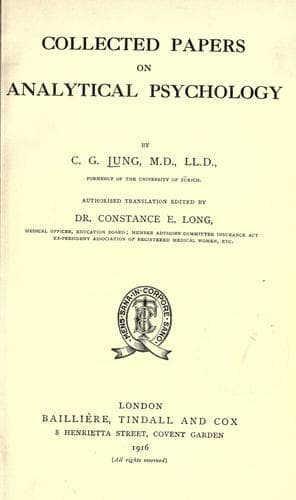
Collected Papers on Analytical PsychologyJung, C. G. (Carl Gustav)
Science
Collected Papers on Analytical Psychology
Jung, C. G. (Carl Gustav)
Psychoanalysis
These states are sometimes attributed to epilepsy, sometimes
to hysteria, sometimes to exhaustion of the nervous system, or
neurasthenia, sometimes they are allowed all the dignity of a disease
_sui generis_. Patients occasionally work through a whole graduated
scale of diagnoses, from epilepsy, through hysteria, up to simulation.
In practice, on the one hand, these conditions can only be separated
with great difficulty from the so-called neuroses, sometimes even are
indistinguishable from them; on the other, certain features in the
region of pathological deficiency present more than a mere analogical
relationship not only with phenomena of normal psychology, but also
with the psychology of the supernormal, of genius. Various as are the
individual phenomena in this region, there is certainly no case that
cannot be connected by some intermediate example with the other typical
cases. This relationship in the pictures presented by hysteria and
epilepsy is very close. Recently the view has even been maintained that
there is no clean-cut frontier between epilepsy and hysteria, and that
a difference is only to be noted in extreme cases. Steffens says, for
example[2]--"We are forced to the conclusion that in essence hysteria
and epilepsy are not fundamentally different, that the cause of the
disease is the same, but is manifest in a diverse form, in different
intensity and permanence."
The demarcation of hysteria and certain borderline cases of epilepsy
from congenital and acquired psychopathic mental deficiency likewise
presents the greatest difficulties. The symptoms of one or other disease
everywhere invade the neighbouring realm, so violence is done to the
facts when they are split off and considered as belonging to one or
other realm. The demarcation of psychopathic mental deficiency from the
normal is an absolutely impossible task, the difference is everywhere
only "more or less." The classification in the region of mental
deficiency itself is confronted by the same difficulty. At best, certain
classes can be separated off which crystallise round some well-marked
nucleus through having peculiarly typical features. Turning away from
the two large groups of intellectual and emotional deficiency, there
remain those deficiencies coloured pre-eminently by hysteria or epilepsy
(epileptoid) or neurasthenia, which are not notably deficiency of the
intellect or of feeling. It is essentially in this region, insusceptible
of any absolute classification, that the above-named conditions play
their part. As is well known, they can appear as part manifestations
of a typical epilepsy or hysteria, or can exist separately in the
realm of psychopathic mental deficiency, where their qualifications of
epileptic or hysterical are often due to the non-essential accessory
features. It is thus the rule to place somnambulism among hysterical
diseases, because it is occasionally a phenomenon of severe hysteria,
Public-domain text, read in full here on John Shaqi.
Reviews
Reviews
No reviews yet
Be the first to share your thoughts on this work.
Join the Discussion
Join the discussion
Sign in to leave a comment or review.
Sign InorCreate an account