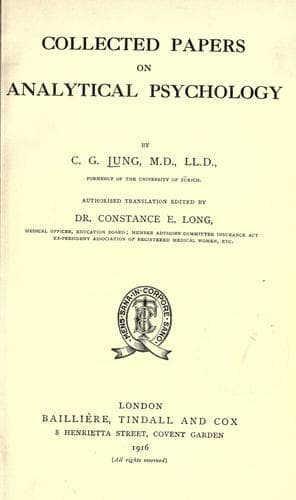
Collected Papers on Analytical PsychologyJung, C. G. (Carl Gustav)
Science
Collected Papers on Analytical Psychology
Jung, C. G. (Carl Gustav)
Psychoanalysis
He believes himself to be an independent thinker, yet a little while
back he undertook a big deal on the Stock Exchange, and when he came
to enter the details of the transaction in his books he noticed with
considerable misgivings that it fell upon a Friday, the 13th of the
month. Therefore, he is also superstitious and not free in his thinking.
So here we are not at all surprised to find these compensating vices
to be an essential content of the unconscious. Obviously, therefore,
the reverse is true--namely, that unconscious virtues compensate for
conscious deficiencies. The law which ought to follow as the result
of such deductions would appear to be quite simple--to wit, the
conscious spendthrift is unconsciously a miser; the philanthropist is
unconsciously an egoist and misanthrope. But, unfortunately, it is
not quite so easy as that, although there is a basis of truth in this
simple rule. For there are essential hereditary dispositions of a latent
or manifest nature which upset the simple rule of compensation, and
which vary greatly in individual cases. From entirely different motives
a man may, for instance, be a philanthropist, but the manner of his
philanthropy depends upon his originally inherited disposition, and the
way in which the philanthropic attitude is compensated depends upon his
motives. It is not sufficient simply to know that a certain person is
philanthropic in order to diagnose an unconscious egoism. For we must
also bring to such a diagnosis a careful study of the motives involved.
In the case of normal people the principal function of the unconscious
is to effect a compensation and thus produce a balance. All extreme
conscious tendencies are softened and toned down through an effective
opposite impulse in the unconscious. This compensating agency, as I have
tried to show in the case of the merchant, maintains itself through
certain unconscious, inconsequent activities, as it were, which Freud
has very well described as symptomatic acts (_Symptom-handlungen_).
To Freud we owe thanks also for having called attention to the
importance of dreams, for by means of them, also, we are able to learn
much about this compensating function. There is a fine historical
example of this in the well-known dream of Nebuchadnezzar in the fourth
chapter of the Book of Daniel, where Nebuchadnezzar at the height of
his power had a dream which foretold his downfall. He dreamed of a tree
which had raised its head even up to heaven and now must be hewn down.
This is a dream which is obviously a counterpoise to the exaggerated
feeling of royal power.
Public-domain text, read in full here on John Shaqi.
Reviews
Reviews
No reviews yet
Be the first to share your thoughts on this work.
Elsewhere in the archive
Join the Discussion
Join the discussion
Sign in to leave a comment or review.
Sign InorCreate an account