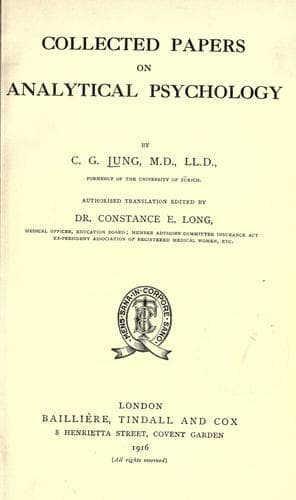
Collected Papers on Analytical PsychologyJung, C. G. (Carl Gustav)
Science
Collected Papers on Analytical Psychology
Jung, C. G. (Carl Gustav)
Psychoanalysis
Now considering states in which the mental balance is disturbed, we can
easily see, from what has preceded, wherein lies the importance of the
unconscious for psychopathology. Let us ponder the question of where
and in what manner the unconscious manifests itself in abnormal mental
conditions. The way in which the unconscious works is most clearly seen
in disturbances of a psychogenic nature, such as hysteria, compulsion
neurosis, etc.
We have known for a long time that certain symptoms of these
disturbances are produced by unconscious psychic events. Just as
clear, but less recognised, are the manifestations of the unconscious
in actually insane patients. As the intuitive ideas of normal men do
not spring from logical combinations of the conscious mind, so the
hallucinations and delusions of the insane arise, not out of conscious
but out of unconscious processes.
Formerly, when we held a more materialistic view of psychiatry we were
inclined to believe that all delusions, hallucinations, stereotypic
acts, etc., were provoked by morbid processes in the brain cells. Such a
theory, however, ignores that delusions, hallucinations, etc., are also
to be met with in certain functional disturbances, and not only in the
case of functional disturbances, but also in the case of normal people.
Primitive people may have visions and hear strange voices without having
their mental processes at all disturbed. To seek to ascribe symptoms
of that nature directly to a disease of the brain cells I hold to be
superficial and unwarranted. Hallucinations show very plainly how a part
of the unconscious content can force itself across the threshold of the
conscious. The same is true of a delusion whose appearance is at once
strange and unexpected by the patient.
The expression "mental balance" is no mere figure of speech, for its
disturbance is a real disturbance of that equilibrium which actually
exists between the unconscious and conscious content to a greater extent
than has heretofore been recognised or understood. As a matter of fact,
it amounts to this--that the normal functioning of the unconscious
processes breaks through into the conscious mind in an abnormal manner,
and thereby disturbs the adaptation of the individual to his environment.
Public-domain text, read in full here on John Shaqi.
Reviews
Reviews
No reviews yet
Be the first to share your thoughts on this work.
Elsewhere in the archive
Join the Discussion
Join the discussion
Sign in to leave a comment or review.
Sign InorCreate an account