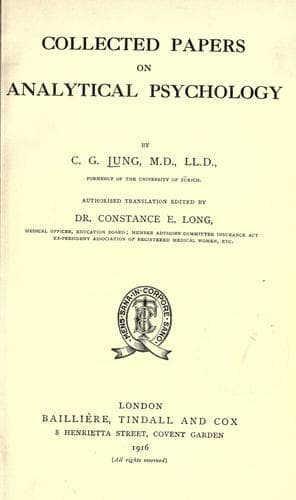
Collected Papers on Analytical PsychologyJung, C. G. (Carl Gustav)
Science
Collected Papers on Analytical Psychology
Jung, C. G. (Carl Gustav)
Psychoanalysis
If we study attentively the history of any such person coming under
our observation, we shall often find that he has been living for a
considerable time in a sort of peculiar individual isolation, more or
less shut off from the world of reality. This constrained condition
of aloofness may be traced back to certain innate or early acquired
peculiarities, which show themselves in the events of his life. For
instance, in the histories of those suffering from dementia præcox
we often hear such a remark as this: "He was always of a pensive
disposition, and much shut up in himself. After his mother died he
cut himself off still more from the world, shunning his friends and
acquaintances." Or again, we may hear, "Even as a child he devised many
peculiar inventions; and later, when he became an engineer, he occupied
himself with most ambitious schemes."
Without discussing the matter further it must be plain that a
counterpoise is produced in the unconscious as a compensation to the
one-sidedness of the conscious attitude. In the first case we may expect
to find an increasing pressing forward in the unconscious, of a wish
for human intercourse, a longing for mother, friends, relatives; while
in the second case self-criticism will try to establish a correcting
balance. Among normal people a condition never arises so one-sided
that the natural corrective tendencies of the unconscious entirely
lose their value in the affairs of everyday life; but in the case of
abnormal people, it is eminently characteristic that the individual
entirely fails to recognise the compensating influences which arise in
the unconscious. He even continues to accentuate his one-sidedness; this
is in accord with the well-known psychological fact that the worst enemy
of the wolf is the wolf-hound, the greatest despiser of the negro is the
mulatto, and that the biggest fanatic is the convert; for I should be a
fanatic were I to attack a thing outwardly which inwardly I am obliged
to concede as right.
The mentally unbalanced man tries to defend himself against his own
unconscious, that is to say, he battles against his own compensating
influences. The man already dwelling in a sort of atmosphere of
isolation, continues to remove himself further and further from the
world of reality, and the ambitious engineer strives by increasingly
morbid exaggerations of invention to disprove the correctness of his own
compensating powers of self-criticism. As a result of this a condition
of excitation is produced, from which results a great lack of harmony
between the conscious and unconscious attitudes. The pairs of opposites
are torn asunder, the resulting division or strife leads to disaster,
for the unconscious soon begins to intrude itself violently upon the
conscious processes. Then odd and peculiar thoughts and moods supervene,
and not infrequently incipient forms of hallucination, which clearly
bear the stamp of the internal conflict.
Public-domain text, read in full here on John Shaqi.
Reviews
Reviews
No reviews yet
Be the first to share your thoughts on this work.
Elsewhere in the archive
Join the Discussion
Join the discussion
Sign in to leave a comment or review.
Sign InorCreate an account