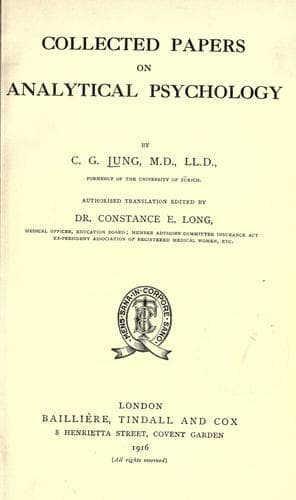
Collected Papers on Analytical PsychologyJung, C. G. (Carl Gustav)
Science
Collected Papers on Analytical Psychology
Jung, C. G. (Carl Gustav)
Psychoanalysis
These corrective impulses or compensations which now break through into
the conscious mind, should theoretically be the beginning of the healing
process, because through them the previously isolated attitude should
apparently be relieved. But in reality this does not result, for the
reason that the unconscious corrective impulses which thus succeed in
making themselves apparent to the conscious mind, do so in a form that
is altogether unacceptable to consciousness.
The isolated individual begins to hear strange voices, which accuse him
of murder and all sorts of crimes. These voices drive him to desperation
and in the resulting agitation he attempts to get into contact with the
surrounding _milieu_, and does what he formerly had anxiously avoided.
The compensation, to be sure, is reached, but to the detriment of the
individual.
The pathological inventor, who is unable to profit by his previous
failures, by refusing to recognise the value of his own self-criticism,
becomes the creator of still more preposterous designs. He wishes to
accomplish the impossible but falls into the absurd. After a while he
notices that people talk about him, make unfavourable remarks about him,
and even scoff at him. He believes a far-reaching conspiracy exists
to frustrate his discoveries and render them objects of ridicule. By
this means his unconscious brings about the same results that his
self-criticism could have attained, but again only to the detriment of
the individual, because the criticism is projected into his surroundings.
An especially typical form of unconscious compensation--to give a
further example--is the paranoia of the alcoholic. The alcoholic loses
his love for his wife; the unconscious compensation tries to lead him
back again to his duty, but only partially succeeds, for it causes him
to become jealous of his wife as if he still loved her. As we know, he
may even go so far as to kill both his wife and himself, merely out of
jealousy. In other words, his love for his wife has not been entirely
lost, it has simply become subliminal; but from the realm of the
unconscious it can now only reappear in the form of jealousy.
We see something of a similar nature in the case of religious converts.
One who turns from protestantism to catholicism has, as is well known,
the tendency to be somewhat fanatical. His protestantism is not entirely
relinquished, but has merely disappeared into the unconscious, where it
is constantly at work as a counter-argument against the newly acquired
catholicism. Therefore the new convert feels himself constrained to
defend the faith he has adopted in a more or less fanatical way. It
is exactly the same in the case of the paranoiac, who feels himself
constantly constrained to defend himself against all external criticism,
because his delusional system is too much threatened from within.
Public-domain text, read in full here on John Shaqi.
Reviews
Reviews
No reviews yet
Be the first to share your thoughts on this work.
Elsewhere in the archive
Join the Discussion
Join the discussion
Sign in to leave a comment or review.
Sign InorCreate an account