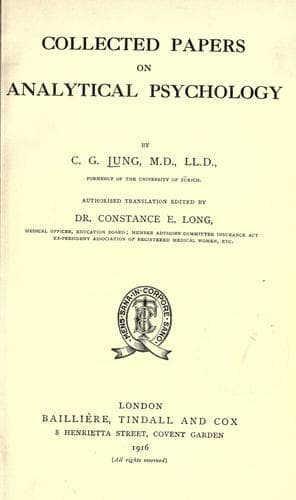
Collected Papers on Analytical PsychologyJung, C. G. (Carl Gustav)
Science
Collected Papers on Analytical Psychology
Jung, C. G. (Carl Gustav)
Psychoanalysis
The strange manner in which these compensating influences break through
into the conscious mind derives its peculiarities from the fact that
they have to struggle against the resistances already existing in the
conscious mind, and therefore present themselves to the patient's mind
in a thoroughly distorted manner. And secondly, these compensating
equivalents are obliged necessarily to present themselves in the
language of the unconscious--that is, in material of a heterogeneous
and subliminal nature. For all the material of the conscious mind which
is of no further value, and can find no suitable employment, becomes
subliminal, such as all those forgotten infantile and phantastic
creations that have ever entered the heads of men, of which only the
legends and myths still remain. For certain reasons which I cannot
discuss further here, this latter material is frequently found in
dementia præcox.
I hope I may have been able to give in this brief contribution, which
I feel to be unfortunately incomplete, a glimpse of the situation
as it presents itself to me of the importance of the unconscious in
psychopathology. It would be impossible in a short discourse to give an
adequate idea of all the work that has already been done in this field.
To sum up, I may say that the function of the unconscious in conditions
of mental disturbance is essentially a compensation of the content
of the conscious mind. But because of the characteristic condition
of one-sidedness of the conscious striving in all such cases, the
compensating correctives are rendered useless. It is, however,
inevitable that these unconscious tendencies break through into the
conscious mind, but in adapting themselves to the character of the
one-sided conscious aims, it is only possible for them to appear in a
distorted and unacceptable form.
FOOTNOTES:
[Footnote 182: Paper given before the Section of Neurology and
Psychological Medicine, Aberdeen, 1914. Reprinted from the _British
Medical Journal_, by kind permission of the Editor, Dr. Dawson Williams.]
CHAPTER XI
A CONTRIBUTION TO THE STUDY OF PSYCHOLOGICAL TYPES[183]
It is well known that in their general physiognomy hysteria and dementia
præcox present a striking contrast, which is seen particularly in the
attitude of the sufferers towards the external world. The reactions
provoked in the hysteric surpass the normal level of intensity of
feeling, whilst this level is not reached at all by the precocious
dement. The picture presented by these contrasted illnesses is one of
exaggerated emotivity in the one, and extreme apathy in the other, with
regard to the environment. In their personal relations this difference
is very marked. Abstraction creates some exceptions here, for we remain
in affective rapport with our hysterical patients, which is not the case
in dementia præcox.
Public-domain text, read in full here on John Shaqi.
Reviews
Reviews
No reviews yet
Be the first to share your thoughts on this work.
Elsewhere in the archive
Join the Discussion
Join the discussion
Sign in to leave a comment or review.
Sign InorCreate an account