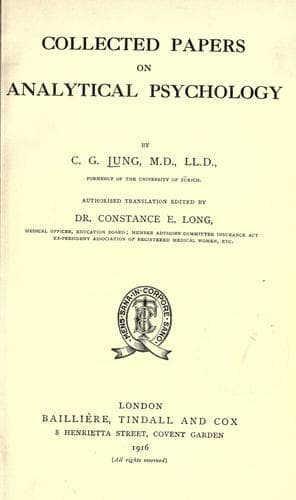
Collected Papers on Analytical PsychologyJung, C. G. (Carl Gustav)
Science
Collected Papers on Analytical Psychology
Jung, C. G. (Carl Gustav)
Psychoanalysis
The opposition between these two nosological types is also seen in
the rest of their symptomatology. From the intellectual point of view
the products of hysterical imagination may be accounted for in a very
natural and human way in each individual case by the antecedents
and individual history of the patient; while the inventions of the
precocious dement, on the contrary, are more nearly related to dreams
than to normal consciousness, and they display moreover an incontestably
archaic tendency, wherein mythological creations of primitive
imagination are more in evidence than the personal memories of the
patient. From the physical point of view we do not find in dementia
præcox those symptoms so common in the hysteric, which simulate well
known or severe organic affections.
All this clearly indicates that hysteria is characterised by a
centrifugal tendency of the libido,[184] whilst in dementia præcox its
tendency is centripetal. The reverse occurs, however, where the illness
has fully established its compensatory effects. In the hysteric the
libido is always hampered in its movements of expansion and forced to
regress upon itself; one observes that such individuals cease to partake
in the common life, are wrapped up in their phantasies, keep their beds,
or are unable to live outside their sick-rooms, etc. The precocious
dement, on the contrary, during the incubation of his illness turns
away from the outer world in order to withdraw into himself; but when
the period of morbid compensation arrives, he seems constrained to draw
attention to himself, and to force himself upon the notice of those
around him, by his extravagant, insupportable, or directly aggressive
conduct.
I propose to use the terms "extroversion" and "introversion" to describe
these two opposite directions of the libido, further qualifying them,
however, as "regressive" in morbid cases where phantasies, fictions,
or phantastic interpretations, inspired by emotivity, falsify the
perceptions of the subject about things, or about himself. We say that
he is extroverted when he gives his fundamental interest to the outer or
objective world, and attributes an all-important and essential value to
it: he is introverted, on the contrary, when the objective world suffers
a sort of depreciation, or want of consideration, for the sake of the
exaltation of the individual himself, who then monopolising all the
interest, grows to believe no one but himself worthy of consideration.
I will call "regressive extroversion" the phenomenon which Freud calls
"transference" (Übertragung), by which the hysteric projects into the
objective world the illusions, or subjective values of his feelings.
In the same way I shall call "regressive introversion," the opposite
pathological phenomenon which we find in dementia præcox, where the
subject himself suffers these phantastical transfigurations.
Public-domain text, read in full here on John Shaqi.
Reviews
Reviews
No reviews yet
Be the first to share your thoughts on this work.
Elsewhere in the archive
Join the Discussion
Join the discussion
Sign in to leave a comment or review.
Sign InorCreate an account