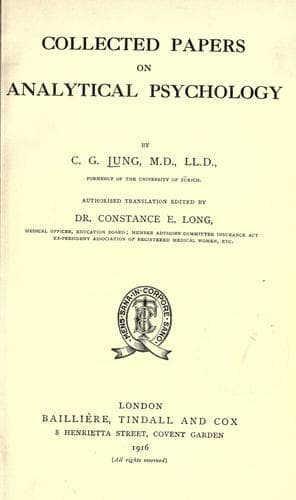
Collected Papers on Analytical PsychologyJung, C. G. (Carl Gustav)
Science
Collected Papers on Analytical Psychology
Jung, C. G. (Carl Gustav)
Psychoanalysis
It is obvious that these two contrary movements of the libido, as
simple psychic mechanisms, may play a part alternately in the same
individual, since after all they serve the same purpose by different
methods--namely, to minister to his well-being. Freud has taught us
that in the mechanism of hysterical transference the individual aims
at getting rid of disagreeable memories or impressions, in order to
free himself from painful complexes, by a process of "repression."
Conversely in the mechanism of introversion, the personality tends to
concentrate itself upon its complexes, and with them, to isolate itself
from external reality, by a process which is not properly speaking
"repression," but which would be better rendered perhaps by the term
"depreciation" (Entwertung) of the objective world.
The existence of two mental affections so opposite in character as
hysteria and dementia præcox, in which the contrast rests on the almost
exclusive supremacy of extroversion or introversion, suggests that these
two psychological types may exist equally well in normal persons, who
may be characterised by the relative predominance of one or other of
the two mechanisms. Psychiatrists know very well that before either
illness is fully declared, patients already present the characteristic
type, traces of which are to be found from the earliest years of life.
As Binet pointed out so well, the neurotic only accentuates and shews
in relief the characteristic traits of his personality. One knows, of
course, that the hysterical character is not simply the product of the
illness, but pre-existed it in a measure. And Hoch has shown by his
researches into the histories of his dementia præcox patients, that this
is also the case with them; dissociations or eccentricities were present
before the onset of the illness. If this is so, one may certainly expect
to meet the same contrast between psychological temperaments outside
the sphere of pathology. It is moreover easy to cull from literature
numerous examples which bear witness to the actual existence of these
two opposite types of mentality. Without pretending to exhaust the
subject, I will give a few striking examples.
In my opinion, we owe the best observations on this subject to the
philosophy of William James.[185] He lays down the principle that no
matter what may be the temperament of a "professional philosopher,"
it is this temperament which he feels himself forced to express
and to justify in his philosophy. And starting from this idea,
which is altogether in accord with the spirit of psychoanalysis,
divides philosophers into two classes: the "tender-minded," who are
only interested in the inner life and spiritual things; and the
"tough-minded," who lay most stress on material things and objective
reality. We see that these two classes are actuated by exactly opposite
tendencies of the libido: the "tender-minded" represent introversion,
the "tough-minded" extroversion.
Public-domain text, read in full here on John Shaqi.
Reviews
Reviews
No reviews yet
Be the first to share your thoughts on this work.
Elsewhere in the archive
Join the Discussion
Join the discussion
Sign in to leave a comment or review.
Sign InorCreate an account