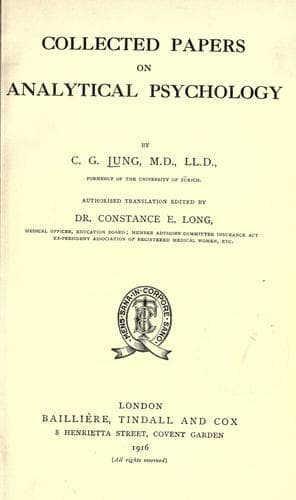
Collected Papers on Analytical PsychologyJung, C. G. (Carl Gustav)
Science
Collected Papers on Analytical Psychology
Jung, C. G. (Carl Gustav)
Psychoanalysis
James says that the tender-minded are characterised by rationalism;
they are men of principles and of systems, they aspire to dominate
experience and to transcend it by abstract reasoning, by their logical
deductions, and purely rational conceptions. They care little for facts,
and the multiplicity of phenomena hardly embarrasses them at all: they
forcibly fit data into their ideal constructions, and reduce everything
to their _a priori_ premises. This was the method of Hegel in settling
beforehand the number of the planets. In the domain of mental pathology
we again meet this kind of philosopher in paranoiacs, who, without
being disquieted by the flat contradictions presented by experience,
impose their delirious conceptions on the universe, and find means of
interpreting everything, and according to Adler "arranging" everything,
in conformity with their morbidly preconceived system.
The other traits which James depicts in this type follow naturally
from its fundamental character. The tender-minded man, he says, is
intellectual, idealist, optimist, religious, partisan of free-will,
a monist, and a dogmatist. All these qualities betray the almost
exclusive concentration of the libido upon the intellectual life.
This concentration upon the inner world of thought is nothing else
than introversion. In so far as experience plays a _rôle_ with these
philosophers, it serves only as an allurement or fillip to abstraction,
in response to the imperative need to fit forcibly all the chaos of the
universe within well-defined limits, which are, in the last resort, the
creation of a spirit obedient to its subjective values.
The tough-minded man is positivist and empiricist. He regards only
matters of fact. Experience is his master, his exclusive guide and
inspiration. It is only empirical phenomena demonstrable in the outside
world which count. Thought is merely a reaction to external experience.
In the eyes of these philosophers principles are never of such value
as facts; they can only reflect and describe the sequence of phenomena
and cannot construct a system. Thus their theories are exposed to
contradiction under the overwhelming accumulation of empirical material.
Psychic reality for the positivist limits itself to the observation
and experience of pleasure and pain; he does not go beyond that, nor
does he recognise the rights of philosophical thought. Remaining on the
ever-changing surface of the phenomenal world, he partakes himself of
its instability; carried away in the chaotic tumult of the universe, he
sees all its aspects, all its theoretical and practical possibilities,
but he never arrives at the unity or the fixity of a settled system,
which alone could satisfy the idealist or tender-minded. The positivist
depreciates all values in reducing them to elements lower than
themselves; he explains the higher by the lower, and dethrones it, by
showing that it is "nothing but such another thing," which has no value
in itself.
Public-domain text, read in full here on John Shaqi.
Reviews
Reviews
No reviews yet
Be the first to share your thoughts on this work.
Elsewhere in the archive
Join the Discussion
Join the discussion
Sign in to leave a comment or review.
Sign InorCreate an account