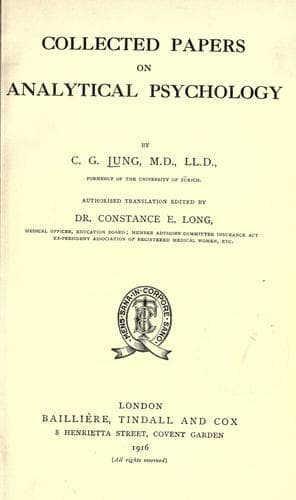
Collected Papers on Analytical PsychologyJung, C. G. (Carl Gustav)
Science
Collected Papers on Analytical Psychology
Jung, C. G. (Carl Gustav)
Psychoanalysis
From these general characteristics, the others which James points out
logically follow. The positivist is a sensualist, giving greater value
to the specific realm of the senses than to reflection which transcends
it. He is a materialist and a pessimist, for he knows only too well the
hopeless uncertainty of the course of things. He is irreligious, not
being in a state to hold firmly to the realities of the inner world
as opposed to the pressure of external facts; he is a determinist and
fatalist, only able to show resignation; a pluralist, incapable of all
synthesis; and finally a sceptic, as a last and inevitable consequence
of all the rest.
The expressions, therefore, used by James, show clearly that the
diversity of types is the result of a different localisation of the
libido; this libido is the magic power in the depth of our being, which,
following the personality, carries it sometimes towards internal life,
and sometimes towards the objective world. James compares, for example,
the religious subjectivism of the idealist, and the quasi-religious
attitude of the contemporary empiricist: "Our esteem for facts has not
neutralised in us all religiousness. It is itself almost religious. Our
scientific temper is devout."[186]
A second parallel is furnished by Wilhelm Ostwald,[187] who divides
"savants" and men of genius into classics and romantics. The latter
are distinguished by their rapid reactions, their extremely prompt and
abundant production of ideas and projects, some of which are badly
digested and of doubtful value. They are admirable and brilliant
masters, loving to teach, of a contagious ardour and enthusiasm, which
attracts many pupils, and makes them founders of schools, exercising
great personal influence. Herein our type of extroversion is easily
recognised. The classics of Ostwald are, on the contrary, slow to react;
they produce with much difficulty, are little capable of teaching or
of exercising direct personal influence, and lacking enthusiasm are
paralysed by their own severe criticism, living apart and absorbed in
themselves, making scarcely any disciples, but producing works of
finished perfection which often bring them posthumous fame. All these
characteristics correspond to introversion.
Public-domain text, read in full here on John Shaqi.
Reviews
Reviews
No reviews yet
Be the first to share your thoughts on this work.
Elsewhere in the archive
Join the Discussion
Join the discussion
Sign in to leave a comment or review.
Sign InorCreate an account