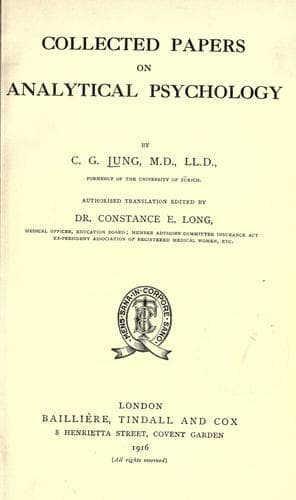
Collected Papers on Analytical PsychologyJung, C. G. (Carl Gustav)
Science
Collected Papers on Analytical Psychology
Jung, C. G. (Carl Gustav)
Psychoanalysis
We find a further very valuable example in the æsthetic theory of
Warringer. Borrowing from A. Riegl his expression "Volonté d'art
absolue" to express the internal force which inspires the artist, he
distinguishes two forms, viz. sympathy (Einfühlung) and abstraction;
and the term which he employs indicates that here, too, we witness the
activity of the push of the libido, the stirring of the _élan vital_.
"In the same way," says Warringer, "as the sympathetic impulse finds its
satisfaction in organic beauty, so abstract impulse discovers beauty in
the inorganic, which is the negation of all life, in crystallised forms,
and in a general manner wherever the severity of abstract law reigns."
Whilst sympathy represents the warmth of passion which carries it into
the presence of the object in order to assimilate it and penetrate
it with emotional values; abstraction, on the other hand, despoils
the object of all that could recall life, and grasps it by purely
intellectual thought, crystallised and fixed into the rigid forms of
law,--the universal, the typical. Bergson also makes use of these images
of crystallisation, solidification, etc., to illustrate the essence of
intellectual abstraction.
Warringer's "abstraction" represents the process which I have already
remarked as a consequence of introversion, namely, the exaltation of
the intellect, in the place of the depreciated reality of the external
world. "Sympathy" corresponds in fact to extroversion, for, as Lipps
has pointed out, "What I perceive sympathetically in an object is, in
a general manner life, and life is power, internal work, effort, and
execution. To live, in a word, is to act, and to act is to experience
intimately the force which we give out; experience creates activity,
which is essentially of a spontaneous character." "Æsthetic enjoyment,"
said Warringer, "is the enjoyment of one's own self projected into the
"object," a formula which corresponds absolutely with our definition of
transference. This æsthetic conception does not refer to the positivist
in James's sense; it is rather the attitude of the idealist for whom
psychological reality only is interesting, and worthy of consideration."
Warringer adds, "what is essential lies not in the gradation of the
feeling, but pre-eminently in the feeling itself; that is to say, the
inner movement, the intimate life, the unfolding of the subject's own
activity; the value of a line or of a form, depends in our eyes on the
biological value it holds for us; that which gives beauty is solely
our own vital feeling, which we unconsciously project into it." This
view corresponds exactly with my own way of understanding the theory
of the libido, in attempting to keep the true balance between the two
psychological opposites of introversion and extroversion.
Public-domain text, read in full here on John Shaqi.
Reviews
Reviews
No reviews yet
Be the first to share your thoughts on this work.
Elsewhere in the archive
Join the Discussion
Join the discussion
Sign in to leave a comment or review.
Sign InorCreate an account