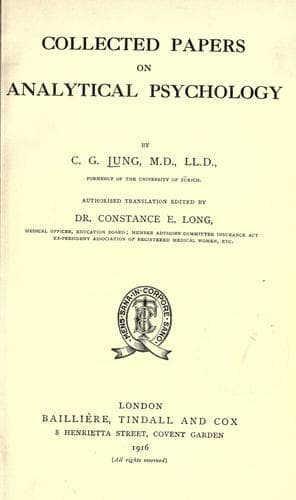
Collected Papers on Analytical PsychologyJung, C. G. (Carl Gustav)
Science
Collected Papers on Analytical Psychology
Jung, C. G. (Carl Gustav)
Psychoanalysis
The polar opposite of sympathy is abstraction. The impulse of
abstraction is conceived by Warringer "as the result of a great internal
conflict of the human soul in the presence of the external world, and
from the religious standpoint, it corresponds to a strong transcendental
colouring of all the representations man has made to himself of
reality." We recognise clearly in this definition the primordial
tendency to introversion. To the introverted type the universe does not
appear beautiful and desirable, but disquieting, and even dangerous;
it is a manifestation against which the subject puts himself on the
defensive; he entrenches himself in his inner fastness, and fortifies
himself therein by the invention of geometrical figures, full of repose,
perfectly clear even in their minutest details, the primitive magic
power of which assures him of domination over the surrounding world.
"The need of abstraction is the origin of all art," says Warringer.
Here is a great principle, which gains weighty confirmation from the
fact that precocious dements reproduce forms and figures which present
the closest analogy to those of primitive humanity, not only in their
thoughts but also in their drawings.
We should recall that Schiller had already tried to formulate the same
presentation in what he calls the naïve and sentimental types. The
latter is in quest of nature, whilst the former is itself "all nature."
Schiller also saw that these two types result from the predominance of
psychological mechanisms which might be met with in one and the same
individual. "It is not only in the same poet," he said, "but even in the
same work that these two types of mentality are found united.... The
naïve poet pursues only nature and feeling in their simplicity, and all
his effort is limited to the imitation and reproduction of reality. The
sentimental poet, on the contrary, reflects the impression he receives
from objects. The object here is allied to an idea, and the poetic power
of the work depends on this alliance." These quotations shew what types
Schiller had in view, and one recognises their fundamental identity with
those with which we are here dealing.
Public-domain text, read in full here on John Shaqi.
Reviews
Reviews
No reviews yet
Be the first to share your thoughts on this work.
Elsewhere in the archive
Join the Discussion
Join the discussion
Sign in to leave a comment or review.
Sign InorCreate an account