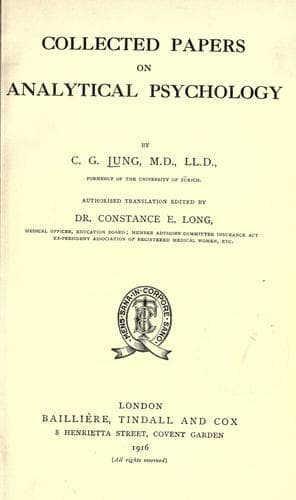
Collected Papers on Analytical PsychologyJung, C. G. (Carl Gustav)
Science
Collected Papers on Analytical Psychology
Jung, C. G. (Carl Gustav)
Psychoanalysis
We find another instance in Nietzsche's contrast between the minds
of Apollo and of Dionysus. The example which Nietzsche uses to
illustrate this contrast is instructive--namely, that between a dream
and intoxication. In a dream the individual is shut up in himself, in
intoxication, on the contrary, he forgets himself to the highest degree,
and, set free from his self-consciousness, plunges into the multiplicity
of the objective world. To depict Apollo, Nietzsche borrows the words of
Schopenhauer, "As upon a tumultuous sea, which disgorges and swallows
by turns, lost to view in the mountains of foaming waves, the mariner
remains seated tranquilly on his plank, full of confidence in his frail
barque; so individual man, in a world of troubles, lives passive and
serene, relying with confidence on the principle of 'individuation.'"
"Yes," continues Nietzsche, "we might say that the unshakeable
confidence in this principle, and the calm security of those whom it has
inspired, have found in Apollo their most sublime expression, and we may
always recognise in him the most splendid and divine personification of
the principle of making an individual." The Apollien state, as Nietzsche
conceives it, is consequently the withdrawal into oneself, that is,
introversion. Conversely in the Dionysian state, psychic intoxication,
indicates in his view the unloosening of a torrent of libido which
expends itself upon things. "This is not only," says Nietzsche, "the
alliance of man with man, which finds itself confirmed afresh under
the Dionysian enchantment; it is alienated Nature, hostile or enslaved,
which also celebrates her reconciliation with her prodigal child,--man.
Spontaneously Earth offers her gifts and the wild beasts from rock and
desert draw near peacefully. The car of Dionysus is lost under flowers
and garlands; panthers and tigers approach under his yoke."
If we change Beethoven's "Hymn of Praise" into a picture, and giving
rein to our imagination, contemplate the millions of beings prostrated
and trembling in the dust, at such a moment the Dionysian intoxication
will be near at hand. Then is the slave free; then all the rigid and
hostile barriers which poverty and arbitrary or insolent custom have
established between man and man are broken down. Now, by means of this
gospel of universal harmony, each feels himself not only reunited,
reconciled, fused with his neighbour, but actually identified with him,
as if the veil of "Maïa was torn away, nothing remaining of it but a few
shreds floating before the mystery of the Primordial Unity."[188] It
would be superfluous to add comment to these quotations.
Public-domain text, read in full here on John Shaqi.
Reviews
Reviews
No reviews yet
Be the first to share your thoughts on this work.
Elsewhere in the archive
Join the Discussion
Join the discussion
Sign in to leave a comment or review.
Sign InorCreate an account