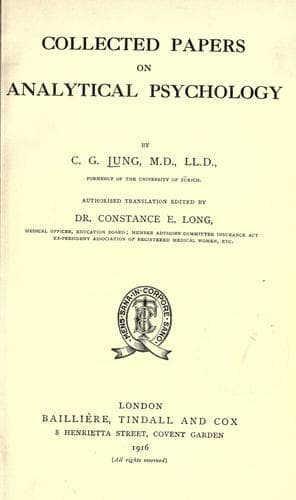
Collected Papers on Analytical PsychologyJung, C. G. (Carl Gustav)
Science
Collected Papers on Analytical Psychology
Jung, C. G. (Carl Gustav)
Psychoanalysis
In concluding this series of examples culled outside my own special
domain, I will quote the linguistic hypothesis of Finck,[189] where we
also see the duality in question. The structure of language, according
to Finck, presents two principal types: in one the subject is generally
conceived as active: "I see him," "I strike him down;" in the other the
subject experiences and feels, and it is the object which acts: "He
appears to me," "He succumbs to me." The first type clearly shews the
libido as going out of the subject,--this is a centrifugal movement;
the second as coming out of the object,--this movement is centripetal.
We meet with this latter introverted type especially in the primitive
languages of the Esquimaux.
In the domain of psychiatry also these two types have been described
by Otto Gross,[190] who distinguishes two forms of mental debility:
the one a diffuse and shallow consciousness, the other a concentrated
and deep consciousness. The first is characterised by weakness of the
consecutive function, the second by its excessive reinforcement. Gross
has recognised that the consecutive function is in intimate relation
with affectivity, from which we might infer that he is dealing once more
with our two psychological types. The relation he establishes between
maniac depressive insanity and the state of diffuse or extended and
shallow mental disease shows that the latter represents the extroverted
type; and the relation between the psychology of the paranoiac and
repressed mentality, indicates the identity of the former with the
introverted type.
After the foregoing considerations no one will be astonished to find
that in the domain of psychoanalysis we also have to reckon with the
existence of these two psychological types.
On the one side we meet with a theory which is essentially reductive,
pluralist, causal and sensualist; this is Freud's standpoint. This
theory limits itself rigidly to empirical facts, and traces back
complexes to their antecedents and their elemental factors. It regards
the psychological life as being only an effect, a reaction to the
environment, and accords the greatest _rôle_ and the largest place to
sensation. On the other side we have the diametrically opposed theory
of Adler[191] which is an entirely philosophical and finalistic one. In
it phenomena are not reducible to earlier and very primitive factors,
but are conceived as "arrangements," the outcome of intentions and
of ends of an extremely complex nature. It is no longer the view of
causality but of finality which dominates researches: the history of the
patient and the concrete influences of the environment are of much less
importance than the dominating principles, the "fictions directrices,"
of the individual. It is not essential for him to depend upon the
object, and to find in it his fill of subjective enjoyment, but to
protect his own individuality and to guarantee it against the hostile
influences of the environment.
Public-domain text, read in full here on John Shaqi.
Reviews
Reviews
No reviews yet
Be the first to share your thoughts on this work.
Elsewhere in the archive
Join the Discussion
Join the discussion
Sign in to leave a comment or review.
Sign InorCreate an account