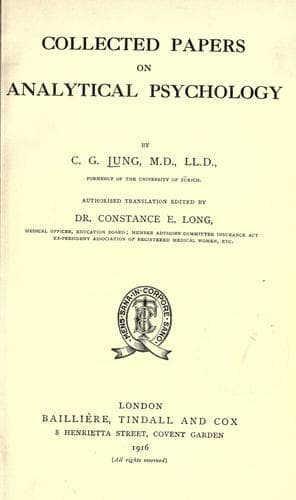
Collected Papers on Analytical PsychologyJung, C. G. (Carl Gustav)
Science
Collected Papers on Analytical Psychology
Jung, C. G. (Carl Gustav)
Psychoanalysis
Whilst Freud's psychology has for its predominant note the centrifugal
tendency, which demands its happiness and satisfaction in the objective
world, in that of Adler the chief _rôle_ belongs to the centripetal
movement, which tends to the supremacy of the subject, to his triumph
and his liberty, as opposed to the overwhelming forces of existence.
The expedient to which the type described by Freud has recourse is
"infantile transference," by means of which he projects phantasy into
the object and finds a compensation for the difficulties of life in this
transfiguration. In the type described by Adler what is characteristic
is, on the contrary, the "virile protest," personal resistance, the
efficacious safeguard which the individual provides for himself, in
affirming and stubbornly enclosing himself in his dominating ideas.
The difficult task of elaborating a psychology which should pay equal
attention to the two types of mentality belongs to the future.
FOOTNOTES:
[Footnote 183: Delivered at the Psychoanalytical Congress, Munich, 1913.
Translated from _Archives de Psychologie_, by kind permission of the
Editor, Dr. Claparède. Translator, C. E. Long.]
[Footnote 184: "The concept of energy is that which comes nearest to
the concept of libido. Libido can perhaps be described as "effect,"
or "capacity for effect." It is capable of transformation from one
form to another. The metamorphosis can be sudden, as when one function
replaces another in a moment of danger; or it can be gradual, as we
see it in the process of sublimation, where the libido is led over a
long and difficult path through a variety of forms into a different
function."--MARY MOLTZER.]
[Footnote 185: "Pragmatism," Chapter I.]
[Footnote 186: "Pragmatism," ch. i., p. 14.]
[Footnote 187: W. Ostwald "Grosse Männer," Leipzig, 1910 (11th Lecture,
"Classics and Romanticists"). See also his contribution, "A propos de la
Biologie du Savant," Bibliothèque Universelle, Oct., 1910.]
[Footnote 188: Nietzsche, "The Birth of Tragedy," trans. Wm. A.
Haussmann.]
[Footnote 189: Finck, "Der deutsche Sprachbon als Aus druck, deutscher
Weltanschauung." Marburg, 1899.]
[Footnote 190: Gross, "Die zerebrale Sekundärfonktion." Leipsig, 1902.]
[Footnote 191: Adler, "Über den nervösen Charakter." Wiesbaden, 1912.]
CHAPTER XII
THE PSYCHOLOGY OF DREAMS[192]
A dream is a psychic structure which at first sight appears to be
in striking contrast with conscious thought, because judging by its
form and substance it apparently does not lie within the continuity
of development of the conscious contents, it is not integral to it,
but is a mere external and apparently accidental occurrence. Its mode
of genesis is in itself sufficient to isolate a dream from the other
contents of the conscious, for it is a survival of a peculiar psychic
activity which takes place during sleep, and does not originate in the
manifest and clearly logical and emotional continuity of the event
experienced.
Public-domain text, read in full here on John Shaqi.
Reviews
Reviews
No reviews yet
Be the first to share your thoughts on this work.
Elsewhere in the archive
Join the Discussion
Join the discussion
Sign in to leave a comment or review.
Sign InorCreate an account