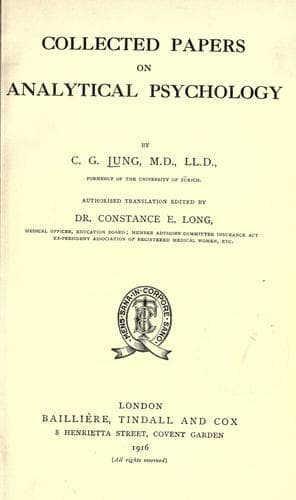
Collected Papers on Analytical PsychologyJung, C. G. (Carl Gustav)
Science
Collected Papers on Analytical Psychology
Jung, C. G. (Carl Gustav)
Psychoanalysis
But a careful observer should have no difficulty in discovering that a
dream is not entirely severed from the continuity of the conscious, for
in almost every dream certain details are found which have their origin
in the impressions, thoughts, or states of mind of one of the preceding
days. In so far a certain continuity does exist, albeit a _retrograde_
one. But any one keenly interested in the dream problem cannot have
failed to observe that a dream has also a _progressive_ continuity--if
such an expression be permitted--since dreams occasionally exert a
remarkable influence upon the conscious mental life, even of persons
who cannot be considered superstitious or particularly abnormal. These
occasional after-effects are usually seen in a more or less distinct
change in the dreamer's frame of mind.
It is probably in consequence of this loose connection with the other
conscious contents, that the recollected dream is so extremely
unstable. Many dreams baffle all attempts at reproduction, even
immediately after waking; others can only be remembered with doubtful
accuracy, and comparatively few can be termed really distinct
and clearly reproduceable. This peculiar reaction with regard to
recollection may be understood by considering the characteristics of the
various elements combined in a dream. The combination of ideas in dreams
is essentially _phantastic_; they are linked together in a sequence
which, as a rule, is quite foreign to our current way of thinking, and
in striking contrast to the logical sequence of ideas which we consider
to be a special characteristic of conscious mental processes.
It is to this characteristic that dreams owe the common epithet of
"meaningless." Before pronouncing this verdict, we must reflect that
dreams and their chains of ideas are something that _we_ do not
understand. Such a verdict would therefore be merely a projection of our
non-comprehension upon its object. But that would not prevent its own
peculiar meaning being inherent in a dream.
In spite of the fact that for centuries endeavours have been made
to extract a prophetic meaning from dreams, Freud's discovery
is practically the first successful attempt to find their real
significance. His work merits the term "scientific," because he has
evolved a technique which, not only he, but many other investigators
also assert achieves its object, namely, the understanding of the
meaning of the dream. This meaning is not identical with the one which
the manifest dream content seems to indicate.
This is not the place for a critical discussion of Freud's psychology of
dreams. But I will try to give a brief summary of what may be regarded
as more or less established facts of dream psychology to-day.
The first question we must discuss is, whence do we deduce the
justification for attributing to dreams any other significance than the
one indicated in the unsatisfying fragmentary meaning of the manifest
dream content?
Public-domain text, read in full here on John Shaqi.
Reviews
Reviews
No reviews yet
Be the first to share your thoughts on this work.
Elsewhere in the archive
Join the Discussion
Join the discussion
Sign in to leave a comment or review.
Sign InorCreate an account