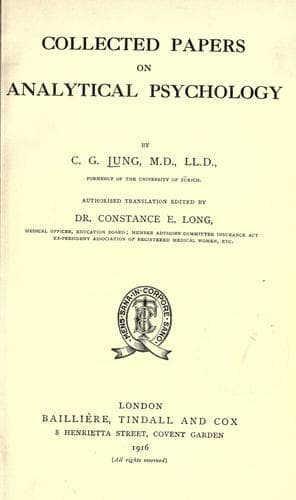
Collected Papers on Analytical PsychologyJung, C. G. (Carl Gustav)
Science
Collected Papers on Analytical Psychology
Jung, C. G. (Carl Gustav)
Psychoanalysis
Let me illustrate with an example. We should be thankful for a
commentary upon "Faust" which traced back all the diverse material of
Part II. to its historical sources, or for a psychological analysis
of Part I. which pointed out how the dramatic conflict corresponds to
a personal conflict in the soul of the poet; we should be glad of an
exposition which pointed out how this subjective conflict is itself
based upon those ultimate and universal human things which are nowise
foreign to us since we all carry the seeds of them in our hearts.
Nevertheless we should be a little disappointed. We do not read "Faust"
just in order to discover that also we are, in all things, "human, all
too human." Alas, we know that but too well already. Let any one who
has not yet learnt it go for a little while out into the world and look
at it without preconceptions and with open eyes. He will turn back from
the might and power of the "too human," hungrily he will pick up his
"Faust," not to find again what he has just left, but to learn how a man
like Goethe shakes off these elemental human things and finds freedom
for his soul. When we once know who was the "Proktophantasmist," to what
chronological events the mass of symbols in Part II. relates, how it is
all intimately bound up with the poet's own soul and conditioned by it,
we come to regard this determination as less important than the problem
itself--what does the poet mean by his symbolic creation? Proceeding
purely reductively, one discovers the final meaning in these universal
human things; and demands nothing further from an explanation than that
the unknown and complicated shall be reduced to the known and simple. I
should like to designate this kind of understanding as _retrospective
understanding_. But there is another kind of understanding, which is not
analytic reduction, but is of a _synthetic_ or _constructive_ nature. I
would designate this _prospective understanding_, and the corresponding
method as the _Constructive method_.
It is common knowledge that present-day scientific explanation rests
upon the basis of the causal principle. Scientific explanation is
causal explanation. We are therefore naturally inclined, whenever we
think scientifically, to explain causally, to understand a thing and
to regard it as explained whenever it is reduced analytically to its
cause and general principle. In so far Freud's psychological method of
interpretation is strictly scientific.
Public-domain text, read in full here on John Shaqi.
Reviews
Reviews
No reviews yet
Be the first to share your thoughts on this work.
Elsewhere in the archive
Join the Discussion
Join the discussion
Sign in to leave a comment or review.
Sign InorCreate an account