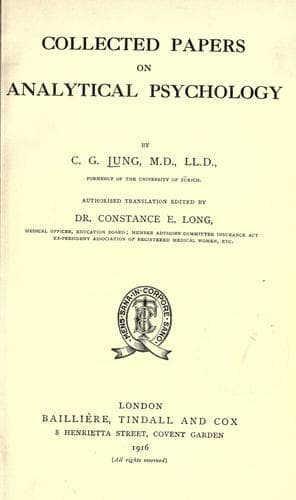
Collected Papers on Analytical PsychologyJung, C. G. (Carl Gustav)
Science
Collected Papers on Analytical Psychology
Jung, C. G. (Carl Gustav)
Psychoanalysis
If we apply this method to "Faust" it must become clear that something
more is required for a true understanding. It will even seem to us
that we have not gathered the poet's deepest meaning if we only see in
it universal foregone human conclusions. What we really want to find
out is how this man has redeemed himself as an individual, and when we
arrive at this comprehension then we shall also understand the symbol
given by Goethe. It is true we may then fall into the error that we
understand Goethe himself. But let us be cautious and modest, simply
saying we have thereby arrived at an understanding of ourselves. I am
thinking here of Kant's thought-compelling definition of comprehension,
as "the realisation of a thing to the extent which is sufficient for our
purpose."
This understanding is, it is true, subjective, and therefore not
scientific for those to whom science and explanation by the causal
principle are identical. But the validity of this identification is open
to question. In the sphere of psychology I must emphasise my doubt on
this point.
We speak of "objective" understanding when we have given a causal
explanation. But at bottom, understanding is a subjective process upon
which we confer the quality "objective" really only to differentiate it
from another kind of understanding which is also a psychological and
subjective process, but upon which, without further ado, we bestow the
quality "subjective." The attitude of to-day only grants scientific
value to "objective" understanding on account of its universal
validity. This standpoint is incontestably correct wherever it is not a
question of the psychological process itself, and hence it is valid in
all sciences apart from pure psychology.
To interpret Faust objectively, _i.e._ from the causal standpoint, is as
though a man were to consider a sculpture from the historical, technical
and--last but not least--from the mineralogical standpoint. But where
lurks the _real meaning_ of the wondrous work? Where is the answer to
that most important question: what aim had the artist in mind, and how
are we ourselves to understand his work subjectively? To the scientific
spirit this seems an idle question which anyhow has nothing to do with
science. It comes furthermore into collision with the causal principle,
for it is a purely speculative constructive view. And the modern world
has overthrown this spirit of scholasticism.
Public-domain text, read in full here on John Shaqi.
Reviews
Reviews
No reviews yet
Be the first to share your thoughts on this work.
Elsewhere in the archive
Join the Discussion
Join the discussion
Sign in to leave a comment or review.
Sign InorCreate an account