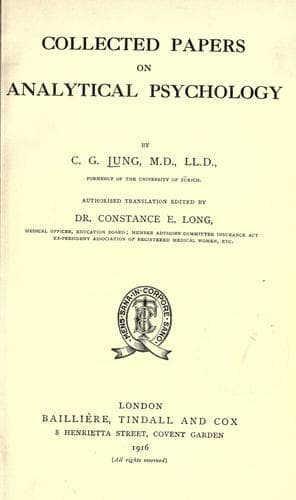
Collected Papers on Analytical PsychologyJung, C. G. (Carl Gustav)
Science
Collected Papers on Analytical Psychology
Jung, C. G. (Carl Gustav)
Psychoanalysis
But if we would approach to an understanding of psychological things we
must remember the fact of the subjective conditioning of all knowledge.
The world is _as we see it_ and not simply objective; this holds true
even more of the mind. Of course it is possible to look at the mind
objectively, just as at Faust, or a Gothic Cathedral. In this objective
conception there is comprised the whole worth and worthlessness of
current experimental psychology and psychoanalysis. The scientific mind,
thinking causally, is incapable of understanding what is ahead; it only
understands what is past, that is, retrospective. Like Ahriman, the
Persian devil, it has the gift of After-Knowledge. But this spirit is
only one half of a complete comprehension. The other more important half
is prospective or constructive; if we are not able to understand what
lies ahead, then nothing is understood. If psychoanalysis, following
Freud's orientation, should succeed in presenting an uninterrupted and
conclusive connection between Goethe's infantile sexual development and
his work, or, following Adler, between the infantile struggle for power
and the adult Goethe and his work, an interesting proposition would have
been solved--we should have learnt how a masterpiece can be reduced to
the simplest thinkable elements, which are universal, and to be found
working within the depths of everything and everybody. But did Goethe
construct his work to _this_ end? Was it his intention that it should be
thus conceived?
It must be sufficiently clear that such an understanding, though
undoubtedly scientific, would be entirely, utterly, beside the mark.
This statement is valid for psychology in general. To understand
the psyche causally, means to understand but half of it. The causal
understanding of Faust enlightens us as to how it became a finished work
of art, but reveals nothing of the living meaning of the poet. That
meaning only lives if we experience it, in and through ourselves. In so
far as our actual present life is for us something essentially new and
not a repetition of all that has gone before, the great value of such
a work is to be seen, not in its causal development, but in its living
reality for our own lives. We should be indeed depreciating a work like
Faust if we were only to regard it as something that has been perfected
and finished; it is only understood when conceived as a becoming and as
an ever new-experiencing.
Thus we must regard the human psyche. Only on one side is the mind a
Has Been, and as such subordinate to the causal principle. On the other
side the mind is a Becoming that can only be grasped synthetically or
constructively. The causal standpoint asks how it is this actual mind
has become what it appears to-day? The constructive standpoint asks how
a bridge can be built from this actual psyche to its own future?
Public-domain text, read in full here on John Shaqi.
Reviews
Reviews
No reviews yet
Be the first to share your thoughts on this work.
Elsewhere in the archive
Join the Discussion
Join the discussion
Sign in to leave a comment or review.
Sign InorCreate an account