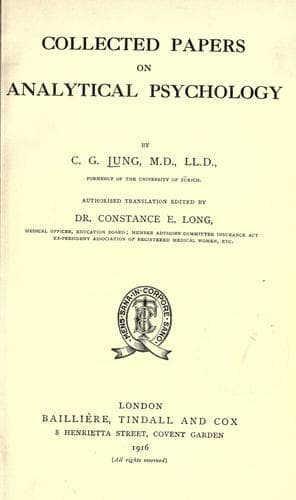
Collected Papers on Analytical PsychologyJung, C. G. (Carl Gustav)
Science
Collected Papers on Analytical Psychology
Jung, C. G. (Carl Gustav)
Psychoanalysis
Just as the causal method finally reaches the general principles of
human psychology by the analysis and reduction of individual events,
so does the constructive standpoint reach aims that are general by the
synthesis of individual tendencies. The mind is a point of passage and
thus necessarily determined from two sides. On the one side it offers a
picture of the precipitate of the past, and on the other side a picture
of the germinating knowledge of all that is to come, in so far as the
psyche creates its own future.
What has been is, on the one hand, the result and apex of all that
was--as such it appears to the causal standpoint; on the other hand, it
is an expression of all that is to be. The future is only _apparently_
like the past, but in its essence always new and unique, (the causal
standpoint would like to invert this sentence) thus the actual formula
is incomplete, germlike so to say, in relation to what is to be.
To get any conception of this expression of what is to be we are forced
to apply a constructive interest to it. I almost felt myself tempted
to say, "a scientific interest." But modern science is identical with
the causal principle. So long as we consider the actual mind causally,
that is scientifically, we elude the mind as a Becoming. This other side
of the psyche can never be grasped by the exclusive use of the causal
principle, but only by means of the constructive standpoint. The causal
standpoint reduces things to their elements, the constructive standpoint
elaborates them into something higher and more complicated. This latter
standpoint is necessarily a speculative one.
Constructive understanding is, however, differentiated from scholastic
speculation because it imposes no general validity, but only subjective
validity. When the speculative philosopher believes he has comprehended
the world once for all by his System, he deceives himself; he has only
comprehended himself and then naïvely projected that view upon the
world. In reaction against this, the scientific method of the modern
world has almost put an end to speculation and gone to the other
extreme. It would create an "objective" psychology. In opposition
to such efforts, the stress which Freud has placed upon individual
psychology is of immortal merit. The extraordinary importance of the
subjective in the development of the objective mental process was thus
first brought adequately into prominence.
Subjective speculation lays no claim to universal validity, it is
identical with constructive understanding. It is a subjective creation,
which, looked at externally, easily seems to be a so-called infantile
phantasy, or at least an unmistakable derivative of it; from an
objective standpoint it must be judged as such, in so far as objective
is regarded as identical with scientific or causal. Looked at from
within, however, constructive understanding means redemption.
"Creation--that is the great redemption from suffering and easiness of
living."[210]
Public-domain text, read in full here on John Shaqi.
Reviews
Reviews
No reviews yet
Be the first to share your thoughts on this work.
Elsewhere in the archive
Join the Discussion
Join the discussion
Sign in to leave a comment or review.
Sign InorCreate an account