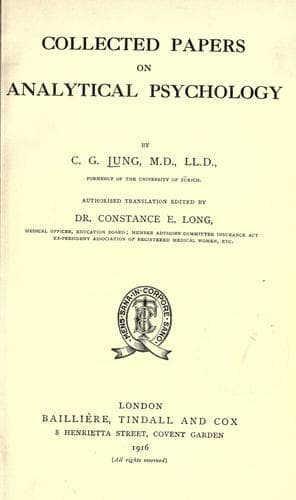
Collected Papers on Analytical PsychologyJung, C. G. (Carl Gustav)
Science
Collected Papers on Analytical Psychology
Jung, C. G. (Carl Gustav)
Psychoanalysis
* * * * *
Starting from these considerations as to the psychology of those
mental patients to whom the Schreber case belongs, we must, from the
"objective-scientific" standpoint, reduce the structural phantasy of the
patient to its simple and most generally valid elements. This Freud had
done. But that is only half of the work to be done. The other half is
the constructive understanding of Schreber's system. The question is:
What end, what freedom, did the patient hope to achieve by the creation
of his system?
The scientific thinker of to-day will regard this question as
inappropriate. The psychiatrist will certainly smile at it, for he is
thoroughly assured of the universal validity of his causalism, he knows
the psyche merely as something that is made, descendent, reactive. Not
uncommonly there lurks the unconscious prejudice that the psyche is a
brain-secretion.
Looking at such a morbid system without preconception, and asking
ourselves what goal this delusional system is aiming at, we see, in
fact, firstly, that it _is_ endeavouring to get at something, and
secondly, that the patient also devotes all his will-power to the
service of the system. There are patients who develop their delusions
with scientific thoroughness, often dragging in an immense material of
comparison and proof. Schreber certainly belongs to this class. Others
do not proceed so thoroughly and learnedly, but content themselves with
heaping up synonymous expressions for that at which they are aiming. The
case of the patient I have described, who assumes all kinds of titles,
is a good instance of this.
The patient's unmistakable striving to express something through and
by means of his delusion Freud conceives retrospectively, as the
satisfaction of his infantile wishes by means of imagination. Adler
reduces it to the desire for power.
For him the delusion-formation is a "manly protest," a means of
gaining security for himself against his menaced superiority. Thus
characterised, this struggle is likewise infantile and the means
employed--the delusional creation--is infantile because insufficient
for its purpose; one can therefore understand why Freud declines to
accept Adler's point of view. Freud, rightly on the whole, subsumes this
infantile struggle for power under the concept of the infantile wish.
Public-domain text, read in full here on John Shaqi.
Reviews
Reviews
No reviews yet
Be the first to share your thoughts on this work.
Elsewhere in the archive
Join the Discussion
Join the discussion
Sign in to leave a comment or review.
Sign InorCreate an account