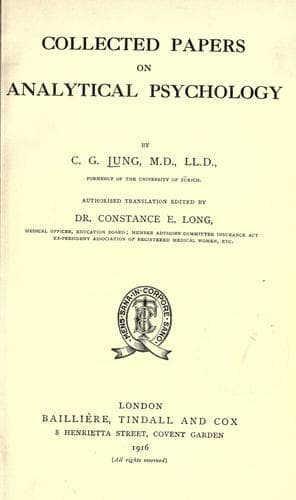
Collected Papers on Analytical PsychologyJung, C. G. (Carl Gustav)
Science
Collected Papers on Analytical Psychology
Jung, C. G. (Carl Gustav)
Psychoanalysis
[Footnote 206: Spielrein: "Über den psychologischen Inhalt eines Falles
von Schizophrene," _l.c._, III., p. 329 ff.]
[Footnote 207: Nelken: "Analytische Beobachtungen über Phantasien eines
Schizophrenen," _l.c._, IV., p. 505 ff.]
[Footnote 208: Grebelskaja: "Psychologische Analyse eines Paranoiden,"
_l.c._, IV., p. 116 ff.]
[Footnote 209: Itten: "Beiträge zur Psychologie der Dementia præcox,"
_l.c._, p. V., 1 ff.]
[Footnote 210: Nietzsche, "Thus spake Zarathustra."]
[Footnote 211: "Quelques faits d'imagination créatrice subconsciente,"
Miss Miller, vol. V., p. 36.]
[Footnote 212: Here "objective" understanding is not identical with
causal understanding.]
[Footnote 213: This energy may also be designated as hormé. Hormé is a
Greek word [Greek: hormê]--force, attack, press, impetuosity, violence,
urgency, zeal. It is related to Bergson's "élan vital." The concept
hormé is an energic expression for psychological values.]
[Footnote 214: See p. 287.]
[Footnote 215: "Die zerebrale Sekundärfunktion." Leipzig, 1902.]
CHAPTER XIV
THE PSYCHOLOGY OF THE UNCONSCIOUS PROCESSES[216]
_Being a Survey of the Modern Theory and Method of Analytical Psychology_
I.--THE BEGINNINGS OF PSYCHOANALYSIS
In common with other sciences, psychology had to go through its
scholastic-philosophic stage, and to some extent this has lasted on
into the present time. This philosophic psychology has incurred our
condemnation in that it decides _ex cathedra_ what is the nature of the
soul, and whence and how it derives its attributes. The spirit of modern
scientific investigation has summarily disposed of all these phantasies
and in their place has established an exact empiric method. We owe to
this our present-day experimental psychology or "_psychophysiology_,"
as the French call it. This new direction originated with Fechner,
that Janus-minded spirit, who in his remarkable _Psychophysik_ (1860)
embarked on the mighty enterprise of introducing the physical standpoint
into the conception of psychical phenomena. The whole idea of this
work--and not least its astonishing mistakes--proved most fruitful in
results. For Wundt, Fechner's young contemporary, carried on his work,
and it is Wundt's great erudition, enormous power of work and genius for
elaborating methods of experimental research, which have given to modern
psychology its prevailing direction.
Until quite recently experimental psychology remained essentially
academic. The first notable attempt to utilise some few at any rate
of its innumerable experimental methods in the service of practical
psychology came from the psychiatrists of the former Heidelberg school
(Kræpelin, Aschaffenburg, etc.); it is quite intelligible that the
psychotherapists should be the first to feel the urgent need for more
exact knowledge of psychic processes.
Public-domain text, read in full here on John Shaqi.
Reviews
Reviews
No reviews yet
Be the first to share your thoughts on this work.
Elsewhere in the archive
Join the Discussion
Join the discussion
Sign in to leave a comment or review.
Sign InorCreate an account