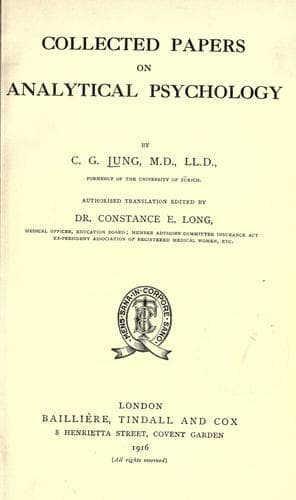
Collected Papers on Analytical PsychologyJung, C. G. (Carl Gustav)
Science
Collected Papers on Analytical Psychology
Jung, C. G. (Carl Gustav)
Psychoanalysis
Next came pedagogy, making its own demands upon psychology. Out of this
has recently grown up an "experimental pedagogy," and in this field
Neumann in Germany and Binet in France have rendered signal services.
The physician, the so-called "nerve-specialist," has the most urgent
need of psychological knowledge if he would really help his patients,
for neurotic disturbances, such as hysteria, and all things classed as
"nervousness," are of psychic origin, and necessarily demand psychic
treatment. Cold water, light, air, electricity, magnetism, etc., are
only effective temporarily, and quite often are of no use at all. They
are frequently introduced into treatment in a not very commendable
fashion, simply because reliance is placed upon their suggestive effect.
But it is in his soul that the patient is really sick; in those most
complicated and lofty functions which we scarcely dare to include in
the province of medicine. The doctor must needs, in such a case, be a
psychologist, must needs understand the human soul. He cannot evade the
urgent demand upon him. So he naturally turns for help to psychology,
since his psychiatry text-books have nothing to offer him. But modern
experimental psychology is very far from being able to afford him any
connected insight into the most vital psychic processes, that is not
its aim. As far as possible it tries to isolate those simple elementary
phenomena which border on the physiological, and then study them in an
isolated state. It quite ignores the infinite variation and movement of
the mental life of the individual, and accordingly, its knowledge and
its facts are so many isolated details, uninspired by any comprehensive
idea capable of bringing them into co-ordination. Hence it comes about
that the inquirer after the secrets of the human soul, learns rather
less than nothing from experimental psychology. He would be better
advised to abandon exact science, take off his scholar's gown, say
farewell to his study, and then, strong in manly courage, set out to
wander through the world; alike through the horrors of prisons, lunatic
asylums and hospitals, through dreary outlying taverns, through
brothels and gambling-halls, into elegant drawing-rooms, the Stock
Exchanges, socialist meetings, churches, revival gatherings of strange
religious sects, experiencing in his own person love and hate and every
kind of suffering. He would return laden with richer knowledge than his
yard-long text-books could ever have given him, and thus equipped, he
can indeed be a physician to his patients, for he understands the soul
of man. He may be pardoned if his respect for the "corner-stones" of
experimental psychology is no longer very considerable. There is a great
gulf fixed between what science calls "psychology," on the one hand, and
what the practice of everyday life expects from psychology on the other.
Public-domain text, read in full here on John Shaqi.
Reviews
Reviews
No reviews yet
Be the first to share your thoughts on this work.
Elsewhere in the archive
Join the Discussion
Join the discussion
Sign in to leave a comment or review.
Sign InorCreate an account