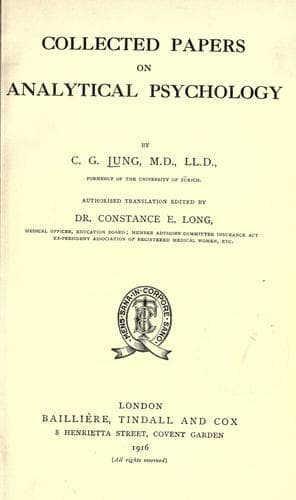
Collected Papers on Analytical PsychologyJung, C. G. (Carl Gustav)
Science
Collected Papers on Analytical Psychology
Jung, C. G. (Carl Gustav)
Psychoanalysis
If the primary presentation disappears, or if it is never conscious at
all, and if the automatic development overlaps neighbouring regions,
we lose every possibility of a demarcation between waking automatisms
and those of the somnambulic state; this will occur, for instance,
if the presentation of a hand plucking the flower gets joined to the
perception of the flower or the presentation of the smell of the flower.
We can then only differentiate it by the more or less. In one case
we then speak of the "waking hallucinations of the normal," in the
other, of the dream-vision of the somnambulists. The interpretation
of our patient's attacks as hysterical becomes more certain by the
demonstration of a probably psychogenic origin of the hallucination.
This is confirmed by her troubles, headache and teno-synovitis, which
have shown themselves amenable to suggestive treatment. The ætiological
factor alone is not sufficient for the diagnosis of hysteria; it might
really be expected _a priori_ that in the course of a disease which is
so suitably treated by rest, as in the treatment of an exhaustion-state,
features would be observed here and there which could be interpreted
as manifestations of exhaustion. The question arises whether the
early lapses and later somnambulic attacks could not be conceived as
states of exhaustion, so-called "neurasthenic crises." We know that in
the realm of psychopathic mental deficiency there can arise the most
diverse epileptoid accidents, whose classification under epilepsy or
hysteria is at least doubtful. To quote C. Westphal: "On the basis of
numerous observations, I maintain that the so-called epileptoid attacks
form one of the most universal and commonest symptoms in the group of
diseases which we reckon among the mental diseases and neuropathies; the
mere appearance of one or more epileptic or epileptoid attacks is not
decisive for its course and prognosis. As mentioned, I have used the
concept of epileptoid in the widest sense for the attack itself."[15]
The epileptoid moments of our case are not far to seek; the objection
can, however, be raised that the colouring of the whole picture is
hysterical in the extreme. Against this, however, it must be stated
that every somnambulism is not _eo ipso_ hysterical. Occasionally
states occur in typical epilepsy which to experts seem parallel with
somnambulic states,[16] or which can only be distinguished by the
existence of genuine convulsions.[17]
As Diehl shows,[18] in neurasthenic mental deficiency crises also occur
which often confuse the diagnosis. A definite presentation-content
can even create a stereotyped repetition in the individual crisis.
Lately Mörchen has published a case of epileptoid neurasthenic twilight
state.[19]
I am indebted to Professor Bleuler for the report of the following
case:--
Public-domain text, read in full here on John Shaqi.
Reviews
Reviews
No reviews yet
Be the first to share your thoughts on this work.
Join the Discussion
Join the discussion
Sign in to leave a comment or review.
Sign InorCreate an account