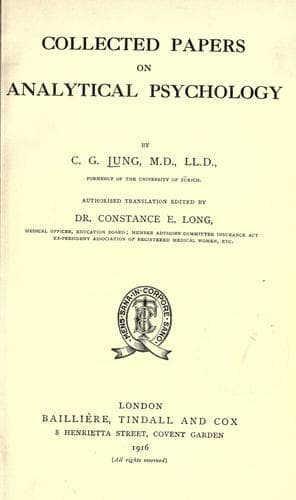
Collected Papers on Analytical PsychologyJung, C. G. (Carl Gustav)
Science
Collected Papers on Analytical Psychology
Jung, C. G. (Carl Gustav)
Psychoanalysis
An educated gentleman of middle age--without epileptic antecedents--had
exhausted himself by many years of over-strenuous mental work. Without
other prodromal symptoms (such as depression, etc.) he attempted suicide
during a holiday; in a peculiar twilight state he suddenly threw himself
into the water from a bank, in sight of many persons. He was at once
pulled out and retained but a fleeting remembrance of the occurrence.
Bearing these observations in mind, neurasthenia must be allowed to
account for a considerable share in the attacks of our patient, Miss
E. K. The headaches and the teno-synovitis point to the existence of
a relatively mild hysteria, generally latent, but becoming manifest
under the influence of exhaustion. The genesis of this peculiar illness
explains the relationship which has been described between epilepsy,
hysteria and neurasthenia.
_Summary._--Miss Elise K. is a psychopathic defective with a tendency
to hysteria. Under the influence of nervous exhaustion she suffers from
attacks of epileptoid giddiness whose interpretation is uncertain at
first sight. Under the influence of an unusually large dose of alcohol
the attacks develop into definite somnambulism with hallucinations,
which are limited in the same way as dreams to accidental external
perceptions. When the nervous exhaustion is cured the hysterical
manifestations disappear.
In the region of psychopathic deficiency with hysterical colouring, we
encounter numerous phenomena which show, as in this case, symptoms of
diverse defined diseases, which cannot be attributed with certainty
to any one of them. These phenomena are partially recognised to be
independent; for instance, pathological lying, pathological reveries,
etc. Many of these states, however, still await thorough scientific
investigation; at present they belong more or less to the domain of
scientific gossip. Persons with habitual hallucinations, and also the
inspired, exhibit these states; they draw the attention of the crowd to
themselves, now as poet or artist, now as saviour, prophet or founder of
a new sect.
Public-domain text, read in full here on John Shaqi.
Reviews
Reviews
No reviews yet
Be the first to share your thoughts on this work.
Join the Discussion
Join the discussion
Sign in to leave a comment or review.
Sign InorCreate an account