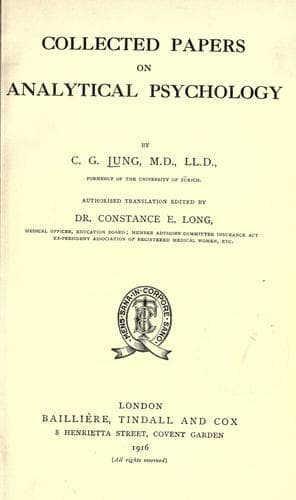
Collected Papers on Analytical PsychologyJung, C. G. (Carl Gustav)
Science
Collected Papers on Analytical Psychology
Jung, C. G. (Carl Gustav)
Psychoanalysis
As regards the criticism encountered by the first edition of this
work, I was pleased to find my writings were received with much more
open-mindedness among English critics than was the case in Germany,
where they are met with the silence born of contempt. I am particularly
grateful to Dr. Agnes Savill for an exceptionally understanding
criticism in the _Medical Press_. My thanks are also due to Dr. T. W.
Mitchell for an exhaustive review in the _Proceedings of the Society for
Psychical Research_. This critic takes exception to my heresy respecting
causality. He considers that I am entering upon a perilous, because
unscientific, course, when I question the sole validity of the causal
view-point in psychology. I sympathise with him, but in my opinion the
nature of the human mind compels us to take the final point of view.
For it cannot be disputed that, psychologically speaking, we are living
and working, day by day, according to the principle of directed aim
or purpose, as well as that of causality. A psychological theory must
necessarily adapt itself to this fact. What is plainly directed towards
a goal cannot be given an exclusively causalistic explanation, otherwise
we should be led to the conclusion expressed in Moleschott's famous
enunciation: "Man _is_, what he eats." We must always bear the fact in
mind that _causality is a point of view_. It affirms the inevitable and
immutable relation of a series of events: a-b-d-z. Since this relation
is fixed, and according to the view-point must necessarily be so,
looked at logically the order may also be reversed. _Finality is also
a view-point_, that is justified empirically solely by the existence
of series of events, wherein the causal connection is indeed evident,
_but the meaning of which only becomes intelligible as producing final
effect_. Ordinary daily life furnishes the best instances of this. The
causal explanation must be mechanistic, if we are not to postulate a
metaphysical entity as first cause. For instance, if we adopt Freud's
sexual theory and assign primary importance psychologically to the
function of the genital glands, the brain is viewed as an appendage of
the genital glands. If we approach the Viennese idea of sexuality with
all its vague omnipotence, and trace it in a strictly scientific manner
down to its psychological basis, we shall arrive at the first cause,
according to which psychic life is for the most, or the most important
part, tension and relaxation of the genital glands. If we assume for the
moment that this mechanistic explanation be "true," it would be the sort
of truth which is exceptionally tiresome and rigidly limited in scope.
A similar statement would be that the genital glands cannot function
without adequate _nourishment_, with its inference that sexuality is an
appendage-function of nutrition! The truth contained in this is really
an important chapter in the biology of lower forms of life.
Public-domain text, read in full here on John Shaqi.
Reviews
Reviews
No reviews yet
Be the first to share your thoughts on this work.
Join the Discussion
Join the discussion
Sign in to leave a comment or review.
Sign InorCreate an account