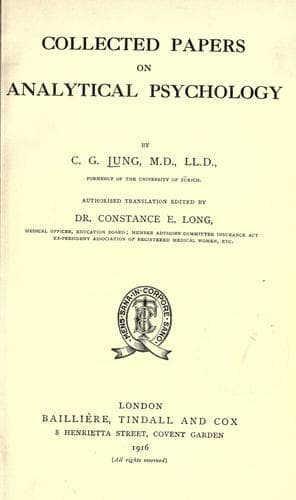
Collected Papers on Analytical PsychologyJung, C. G. (Carl Gustav)
Science
Collected Papers on Analytical Psychology
Jung, C. G. (Carl Gustav)
Psychoanalysis
But if we wish to work in a really psychological way, we shall want
to know the _meaning_ of psychological phenomena. After learning the
kinds of steel the various parts of a locomotive are made of, and from
what ironworks and mines they come, we do not really know anything
about the locomotive's _function_, that is to say, its _meaning_. But
"function" as conceived by modern science is by no means solely a
causal concept; it is especially a final or "teleological" one. For it
is utterly impossible to consider the soul from the causal view-point
only; we are obliged to consider it also from the final point of view.
As Dr. Mitchell also points out, it is impossible for us to think of the
causal determination conjointly with a final connection. That would be
an obvious contradiction. But our theory of cognition does not need to
remain on a pre-Kantian level. It is well known that Kant showed very
clearly that the mechanistic and the teleological view-points are not
_constituent_ (objective) principles, in some degree qualities of the
object, but that they are purely _regulative_ (subjective) principles
of thought, and as such they are not mutually inconsistent. I can, for
example, easily conceive the following thesis and antithesis:--
_Thesis_: Everything came into existence according to
mechanistic laws.
_Antithesis_: Some things did not come into existence
according to mechanistic laws only.
Kant says to this: Reason cannot prove either of these principles,
because _a priori_ purely empirical laws of nature cannot give us a
determinative principle regarding the potentiality of things.
As a matter of fact, modern physics has necessarily been converted from
the idea of pure mechanism to the final concept of the conservation of
energy, because the mechanistic explanation only recognises reversible
processes, whereas the actual truth is that the process of nature is
irreversible. This fact led to the concept of an energy that tends
towards relief of tension, and therewith also towards a definite final
state.
Obviously, I consider both these points of view necessary, the causal as
well as the final, but would at the same time lay stress upon the fact
that since Kant's time we have come to know that the two view-points
are not antagonistic if they are regarded as regulative principles of
thought, and not as constituent principles of the process of nature
itself.
Public-domain text, read in full here on John Shaqi.
Reviews
Reviews
No reviews yet
Be the first to share your thoughts on this work.
Join the Discussion
Join the discussion
Sign in to leave a comment or review.
Sign InorCreate an account