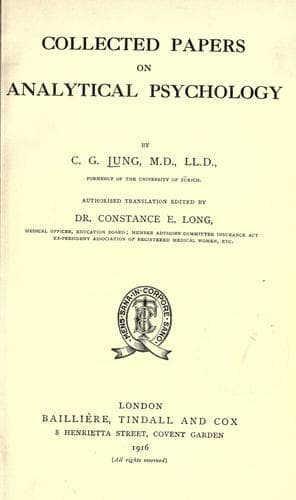
Collected Papers on Analytical PsychologyJung, C. G. (Carl Gustav)
Science
Collected Papers on Analytical Psychology
Jung, C. G. (Carl Gustav)
Psychoanalysis
But here a very important question arises. Can man obey the fundamental
and primitive impulses of his nature without gravely injuring himself
or his fellow beings? He cannot assert either his sexual desire or
his desire for power unlimitedly, and the limits are moreover very
restricted. The Zürich School has in view also the final result
of analysis, and regards the fundamental thoughts and impulses
of the unconscious, as symbols, indicative of a definite line of
future development. We must admit there is, however, _no scientific
justification_ for such a procedure, because our present-day science is
based as a whole upon causality. But causality is only one principle,
and psychology essentially cannot be exhausted by causal methods
only, because the mind lives by aims as well. Besides this disputable
philosophical argument, we have another of much greater value in favour
of our hypothesis, namely, that of _vital necessity_. It is impossible
to live according to the intimations of infantile hedonism, or according
to a childish desire for power. If these are to be retained they must be
taken symbolically. Out of the symbolic application of infantile trends,
an attitude evolves which may be termed philosophic or religious, and
these terms characterise sufficiently the lines of further development
of the individual. The individual is not only an established and
unchangeable complex of psychological facts, but also an extremely
changeable entity. By exclusive reduction to causes, the primitive
trends of a personality are reinforced; this is only helpful when at
the same time these primitive tendencies are balanced by recognition
of their symbolic value. Analysis and reduction lead to causal truth;
this by itself does not help living, but brings about resignation and
hopelessness. On the other hand, the recognition of the intrinsic value
of a symbol leads to constructive truth and helps us to live. It induces
hopefulness and furthers the possibility of future development.
The functional importance of the symbol is clearly shown in the history
of civilisation. For thousands of years the religious symbol proved
a most efficacious means in the moral education of mankind. Only a
prejudiced mind could deny such an obvious fact. Concrete values cannot
take the place of the symbol; only new and more efficient symbols can
be substituted for those that are antiquated and outworn, such as have
lost their efficacy through the progress of intellectual analysis and
understanding. The further development of mankind can only be brought
about by means of symbols which represent something far in advance of
himself, and whose intellectual meanings cannot yet be grasped entirely.
The individual unconscious produces such symbols, and they are of the
greatest possible value in the moral development of the personality.
Public-domain text, read in full here on John Shaqi.
Reviews
Reviews
No reviews yet
Be the first to share your thoughts on this work.
Join the Discussion
Join the discussion
Sign in to leave a comment or review.
Sign InorCreate an account