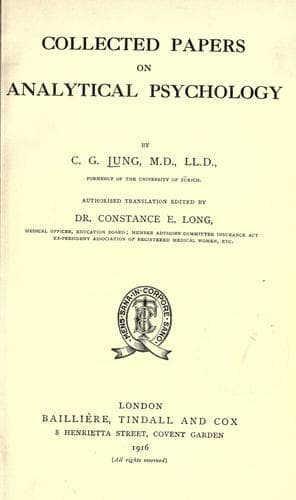
Collected Papers on Analytical PsychologyJung, C. G. (Carl Gustav)
Science
Collected Papers on Analytical Psychology
Jung, C. G. (Carl Gustav)
Psychoanalysis
The value does not depend merely on historical causes; its chief
importance lies in the fact that it has a meaning for the actual
present, and for the future, in their psychological aspects. For to the
Zürich School the symbol is not merely a sign of something repressed and
concealed, but is at the same time an attempt to comprehend and to point
out the way of the further psychological development of the individual.
Thus we add a prospective import to the retrospective value of the
symbol.
The method of the Zürich School is therefore not only analytical and
causal, but also synthetic and prospective, in recognition that the
human mind is characterised by "causæ" and also by "fines" (aims). The
latter fact needs particular emphasis, because there are two types of
psychology, the one following the principle of hedonism, and the other
following the principle of power. Scientific materialism is pertinent
to the former type, and the philosophy of Nietzsche to the latter. The
principle of the Freudian theory is hedonism, while that of Adler (one
of Freud's earliest personal pupils) is founded upon the principle of
power.
The Zürich School, recognising the existence of these two types (also
remarked by the late Professor William James), considers that the views
of Freud and Adler are one-sided, and only valid within the limits of
their corresponding type. Both principles exist within every individual,
but not in equal proportions.
Thus, it is obvious that each psychological symbol has two aspects, and
should be interpreted according to the two principles. Freud and Adler
interpret in the analytical and causal way, reducing to the infantile
and primitive. Thus with Freud the conception of the "aim" is the
fulfilment of desire, with Adler it is the usurpation of power. Both
authors take the standpoint in their practical analytical work which
brings to view only infantile and gross egoistic aims.
The Zürich School is convinced of the fact that within the limits of
a diseased mental attitude the psychology is such as Freud and Adler
describe. It is, indeed, just on account of such impossible and childish
psychology that the individual is in a state of inward dissociation and
hence neurotic. The Zürich School, therefore, in agreement with them so
far, also reduces the psychological symbol (the phantasy products of
the patient) to the fundamental infantile hedonism, or to the infantile
desire for power. But Freud and Adler content themselves with the
result of mere reduction, according to their scientific biologism and
naturalism.
Public-domain text, read in full here on John Shaqi.
Reviews
Reviews
No reviews yet
Be the first to share your thoughts on this work.
Join the Discussion
Join the discussion
Sign in to leave a comment or review.
Sign InorCreate an account