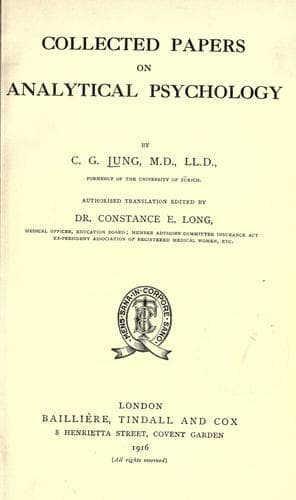
Collected Papers on Analytical PsychologyJung, C. G. (Carl Gustav)
Science
Collected Papers on Analytical Psychology
Jung, C. G. (Carl Gustav)
Psychoanalysis
[Footnote 12: _Arch. de Neur._, Mai, 1891.]
[Footnote 13: "Philosophy of Sleep," 1830. Cf. Binet, "Les Altérations,"
etc.]
[Footnote 14: Goethe: _Zur Naturwissenschaft in Allgemeinen_. "I was
able, when I closed my eyes and bent my head, to conjure the imaginary
picture of a flower. This flower did not retain its first shape for
a single instant, but unfolded out of itself new flowers composed of
coloured petals and green leaves. They were not natural flowers, but
phantastic ones. They were as regular in shape as a sculptor's rosettes.
It was impossible to fix the creation which sprang up, nevertheless the
dream-image lasted as long as I desired it to last; it neither faded nor
grew stronger."]
[Footnote 15: C. Westphal, "Die Agoraphobie," _Arch. f. Psych._, III. p.
158.]
[Footnote 16: Pick, _Arch. f. Psych._, XV. p. 202.]
[Footnote 17: _Allgem. Zeitschr. f. Psych._, XXI. p. 78.]
[Footnote 18: "Neurasthenische Krisen," _Münch. Med. Wochenschr._, März,
1902, "When the patients first describe their crises they generally give
a picture that makes us think of epileptic depression. I have often been
deceived in this way."]
[Footnote 19: Mörchen, "Ueber Dämmerzustände," Marburg, 1901, Fall. 32,
p. 75.]
[Footnote 20: It must be noted that a frequent guest in S. W.'s home was
a gentleman who spoke high German.]
[Footnote 21: Ivenes is the mystical name of the medium's somnambulic
self.]
[Footnote 22: "The Major Symptoms of Hysteria." New York: The Macmillan
Company.]
[Footnote 23: See page 17.]
[Footnote 24: Binet, "Les altérations de la personnalité."]
[Footnote 25: Richet, _Rev. Phil._, 1884, II. p. 650.]
[Footnote 26: Binet, "Les altérations de la personnalité," p. 139.]
[Footnote 27: Complete references in Binet, "Les altérations," p. 197,
footnote.]
[Footnote 28: As is known, during the waking-state the hands and arms
are never quite still, but are constantly subjected to fine tremors.
Preyer, Lehmann, and others have proved that these movements are
influenced in a high degree by the predominant presentations. Preyer
shows that the outstretched hand drew small, more or less faithful,
copies of figures which were vividly presented. These purposeful tremors
can be demonstrated in a very simple way by experiments with the
pendulum.]
[Footnote 29: Cf. Preyer, "Die Erklärung des Gedankenlesens," Leipzig,
1886.]
[Footnote 30: Analogous to certain hypnotic experiments in the waking
state. Cf. Janet's experiment when by a whispered suggestion he
induced a patient to lie flat on the ground without being aware of it
("L'Automatisme").]
[Footnote 31: Charcot's scheme of word-picture combination: 1, Auditory
image. 2, Visual image. 3, Motor image., Speech image., Writing image.
In Gilbert Ballet, "Die innerliche Sprache," Leipzig and Wien, 1890.]
[Footnote 32: Bain says, "Thought is a suppressed word or a suppressed
act" ("The Senses and the Intellect").]
[Footnote 33: _Proceedings of S.P.R._, 1885. "Automatic writing."]
Public-domain text, read in full here on John Shaqi.
Reviews
Reviews
No reviews yet
Be the first to share your thoughts on this work.
Elsewhere in the archive
Join the Discussion
Join the discussion
Sign in to leave a comment or review.
Sign InorCreate an account