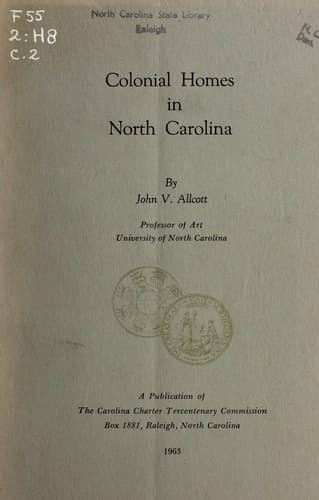
Architecture, Colonial; Architecture, Domestic -- North Carolina; Historic buildings -- North Carolina
The following statement was published in the original printing of
_Colonial Homes of North Carolina_: “The Carolina Charter Tercentenary
Commission was established by the North Carolina General Assembly ‘to
make plans and develop a program for celebration of the tercentenary of
the granting of the Carolina Charter of 1663....’ As part of this
program the Commission arranged for the publication of a number of
historical pamphlets for use in stimulating interest in the study of
North Carolina history during the period 1663-1763. This publication is
part of that project.” Because of the widespread acceptance of this
particular pamphlet and continuing demand for it, the Division of
Archives and History of the North Carolina Department of Cultural
Resources is reprinting it. When the Carolina Charter Tercentenary
Commission went out of existence at the end of 1663, its stock of
publications was turned over to what was then the State Department of
Archives and History. Since that time several of the pamphlets
originally published by the commission have been reprinted.
Because of monetary limitations, it has not been possible to update this
publication. Readers should be aware of the fact that a number of
projects in progress at the time Dr. Allcott wrote the booklet, such as
the Museum of Early Southern Decorative Arts in Winston-Salem and Tryon
Palace in New Bern, have been completed.
Chairman of the Carolina Charter Tercentenary Commission was the
Honorable Francis E. Winslow of Rocky Mount; executive secretary was
Brig. Gen. John D. F. Phillips, U.S. Army (Ret.).
The awareness of the importance of structures of historical significance
has increased with the recent emphasis on historic preservation. It is
appropriate, therefore, that Dr. John V. Allcott’s work on North
Carolina’s colonial homes be kept in print.
Memory F. Mitchell
_Historical Publications Administrator_
July 1, 1975
INTRODUCTION
This booklet, planned for young student readers, discusses a group of
colonial homes scattered over North Carolina, which remain and can be
seen today. They begin in the early 18th century, for earlier homes have
long since disappeared. The fate of these first buildings is likewise
the fate of most of the churches, courthouses, and other non-domestic
structures built during colonial times. Homes, therefore, chiefly
constitute the first group or body of architecture remaining from the
early and mid-18th century.
Public-domain text, read in full here on John Shaqi.
Reviews
Reviews
No reviews yet
Be the first to share your thoughts on this work.
Join the Discussion
Join the discussion
Sign in to leave a comment or review.
Sign InorCreate an account