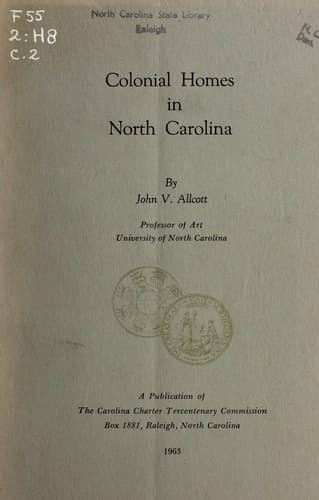
Architecture, Colonial; Architecture, Domestic -- North Carolina; Historic buildings -- North Carolina
Architecture of the final years of the colonial period will be mentioned
only lightly. During this later time new ideas of elegance came into
North Carolina architecture, as in the well known Tryon Palace, to which
we will refer later. For many people who have not thought very much
about colonial architecture, these elegant later buildings, and also
those of the early Republic, stand somehow for all or the best of
“colonial” architecture, and the exciting architecture of an earlier,
bustling, genuinely colonial period is not recognized. It will be useful
in this booklet, therefore, to focus on the architecture of the earlier
18th century and see the simple, vigorous ideas of this period.
These buildings are of surprising variety—they are made of brick, stone,
or wood; they are large and small, plain or fancy in one way or another.
A reason for such diversity is that the colonists, coming from different
foreign countries and settlements in America, brought with them
differing ideas about what a building should look like and how it should
be constructed. These early buildings, however, do hold together as a
group. More important, they show the rise of architectural ideas
especially suited to the hot Carolina summers. Thus, we view our
material both as expressive of a genuine “colonial” period, and as
establishing ideas which reflect Southern life.
[Illustration: Inspecting a house plan]
Besides talking about colonial architecture as an important aspect of
colonial history, this booklet has two special purposes. One is to
interest the student in architecture itself. Some people go through
their whole lives without ever being conscious about buildings they like
or dislike; they do not wonder why one building looks gay, another
sober, and others pompous or unpretentious. This study will provide a
number of approaches to architecture. Using everyday vision, so to
speak, we will see photographs of buildings from outside and inside, in
long-shot and close-up. We will see buildings in plan views and diagrams
which show in a few lines what a photograph cannot. We will look down on
buildings and cities from high in the air (via maps). And we will look
with X-ray eyes into the construction of buildings. In these and other
ways a person begins to experience the manifold realities of
architecture and to understand how architecture ranks with painting and
sculpture as a great, compelling art. Buildings and cities are the
material frame created by man, in which he can breathe and live life as
he desires it.
[Illustration: Inspecting a house foundation]
Public-domain text, read in full here on John Shaqi.
Reviews
Reviews
No reviews yet
Be the first to share your thoughts on this work.
Join the Discussion
Join the discussion
Sign in to leave a comment or review.
Sign InorCreate an account